Showing posts with label just war. Show all posts

Wednesday, September 12, 2007

War - What is it good for?

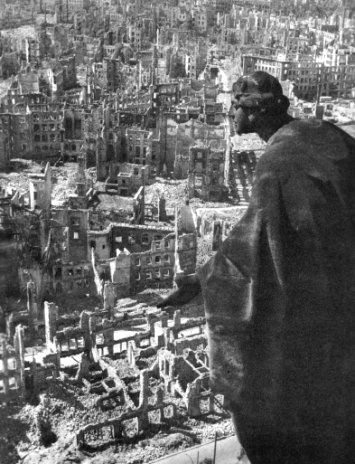
Dresden after it was bombed.

I am not a pacifist. I think that pacificism is not the position of the Scriptures, nor even of Jesus himself (unless you edit him). But I am not comfortable with the label 'just war theorist' either. I have Christian pacifist friends whom I respect a good deal, and I owe a great deal to pacifist writers like Yoder and Hauerwas. One of the problems with pacificism in my view is that automatically you rule out the moral evaluation of acts of war because you disagree with them as a species of act in any case. I would rather allow for the possibility that 'war' is sometimes a necessary action in the pursuit of justice and the protection of the innocent - even if such a war has never been fought.

Two books I have been reading have touched on the appalling futility of war: Martin Gilbert's excellent Somme: The Heroism and Horror of War and A.C. Grayling's Among the Dead Cities - a ethical evaluation of the targeting of civilian populations in war (the answer is 'no, it is never justified' by the way).

Of course, it is no news to discover that war is appalling in almost every respect. Grayling's book shows that even in the case of a (by general consensus) morally 'justified' war (WWII) there were terrible atrocities committed by the victors - in the name of their good cause. The good cause did not sanctify the actions of those who possessed it, clearly.

The reading of these books made me all the more determined to question the West's ongoing pursuit of, and belief in, military action as a geo-political solution all in the name of liberal democracy.


Friday, June 22, 2007

Everard Digges La Touche


My predecessor as a lecturer at Moore College, Everard Digges La Touche, Church of Ireland clergyman and author of a brilliant work of Christology, saw WWI as a holy war against German liberal Protestantism. He joined up to fight against it...

The report of his service is here. I quote an excerpt from it:

"At the outbreak of war in 1914, he tried first to join as a chaplain, then in the ranks of the 2nd. Battalion, Australian Inf. In November 1914, he was rejected because of his severe varicose veins, so he immediately went away and had an operation. This meant that he was too late to join the 2nd. Battalion, but as soon as he was well he joined the 13th and rose to Sergeant. You might wonder why this clergyman, who was not in A1 physical condition, and with the responsibility of his wife, Eve, and two young sons, was prepared to go off and fight, but one of his men summed him up, saying "he convinced us of the righteousness of our cause and likened this present struggle for liberty to a Holy Crusade, so when we finally sang "Onward Christian Soldiers", we meant it".


He was commissioned as a 2nd. Lt. in the 2nd. Battalion when an officer was needed to take reinforcements from Alexandria to Gallipoli, for the August attack. On the morning of the 6th, August 1915, he landed his men at Anzac Cove. As a Reinforcement Officer he could then have chosen to go back to Alexandria, but the official historian says that he begged leave to join the attack at Lone Pine. At 5.30, he went over the parapet with the first rush, only to fall, mortally wounded within a few seconds. He managed to roll down the slope of the spur and crawl back into the Australian lines, dying "among his own people" as Charles Bean the Australian war historian described it.”

They don't make 'em like they used to!

Wednesday, June 13, 2007

O'Donovan on Just War and Martyrdom

It is hard to please everyone all the time.

When it comes to martyrdom, I think OMTO'D has the lines just right here:

...a Christian witness to God's peace must always be acted out agianst the horizon of suffering and martyrdom. Suffering and martyrdom mark the point at which the possibilities of true judgment run out within the conditions of the word. They are necessary components of Christian practical reason, because they demonstrate the vulnerability of the praxis of judgment, and so protect it from serious misunderstanding. Judgment is an undertaking always under threat within the terms of this world, always liable to be overwhelmed by violence. It cannot possibly issue a licence to avoid defeat by all possibe means...Yet the horzon on which we are called to suffer and to die rather than wrong our neighbour is not reached before we actually reach it. The possibilities of active witness to God's peace are not exhausted until we have exhausted them, which we will not have done if have not explored them. In this context...the dutuies which confront us do not BEGIN with martyrdom; they END with it, when we have gone as far as we are permitted to go, done as much as we are permitted to do. Martyrdom is not, in fact, a strategy for DOING anything, but a testimony to God's faithfulness when there is nothing left to do. p. 9-10

I love that: martyrdom is no strategy. How could it be?

Wednesday, April 25, 2007

Just War and Atonement?

Over at Faith and Theology there has been a vigorous discussion after Ben invited nominations for the 'Worst Theological Invention Ever'. Everyone loves a gripe, me included!

Several of the contributors nominated Just War theory, with one of them actually noting a link between those who hold JW and those who hold to Penal Substitution.

This is just tendentious, and a bad reading of even the pacificist tradition. As Miroslav Volf points out in Exclusion and Embrace, many of the strongest pacificists in Christianity - in the early church and in the radical reformation - have also held to a vigorous account of the divine wrath against sin and sinners, and the need for a substitionary sin-bearer. It is precisely this account that enables there to be a meaningful pacificism.

Which leads me to a further observation: there are two types of pacificism. There is the one I have just described, which, though I think it has weaknesses, is orthodox and ancient (though it is a minority report). The other rests on a doctrine of God that is frankly novel, reading out of an ontology of God's peace that is exegetically and theologically unconvincing (in my opinion), owing more to Foucault than anything. Or at least, to put it less combatitively, if pacificism rests on such a doctrine of God then there are really two very different conceptions of the nature of God at play.

Christendom has also come under attack (again!), as if one could make meaningfully sweeping generalisations about a millenia of thought about this era in the history of the church! Christendom had its bad fruit, certainly, as it had its wonderful benefits for humankind and for the gospel; and I am not yet urging a return to it (as if I could) out of some Christian nostalgia: but the flaw was not in the idea of Christendom itself - at least not as it properly and accurately described.