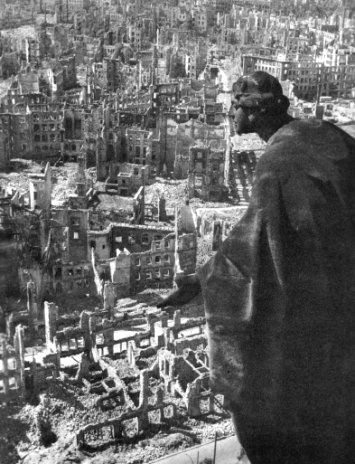
 Dresden after it was bombed.
I am not a pacifist. I think that pacificism is not the position of the Scriptures, nor even of Jesus himself (unless you edit him). But I am not comfortable with the label 'just war theorist' either. I have Christian pacifist friends whom I respect a good deal, and I owe a great deal to pacifist writers like Yoder and Hauerwas. One of the problems with pacificism in my view is that automatically you rule out the moral evaluation of acts of war because you disagree with them as a species of act in any case. I would rather allow for the possibility that 'war' is sometimes a necessary action in the pursuit of justice and the protection of the innocent - even if such a war has never been fought.
Two books I have been reading have touched on the appalling futility of war: Martin Gilbert's excellent Somme: The Heroism and Horror of War and A.C. Grayling's Among the Dead Cities - a ethical evaluation of the targeting of civilian populations in war (the answer is 'no, it is never justified' by the way).
Of course, it is no news to discover that war is appalling in almost every respect. Grayling's book shows that even in the case of a (by general consensus) morally 'justified' war (WWII) there were terrible atrocities committed by the victors - in the name of their good cause. The good cause did not sanctify the actions of those who possessed it, clearly.
The reading of these books made me all the more determined to question the West's ongoing pursuit of, and belief in, military action as a geo-political solution all in the name of liberal democracy.


7 comments:
The reading of these books made me all the more determined to question the West's ongoing pursuit of, and belief in, military action as a geo-political solution all in the name of liberal democracy.
Indeed. Walter Wink talks about this (although he is far more broad in his application than talking about merely the promotion of liberal democracy) as the "myth of redemptive violence".
My position as a pacifist stems firstly from what I believe my commitment is as an individual and then extends outward into the corporate sphere. Violence, whether individual or corporate is never the answer. Not only does violence undermine the dignity of the victim (whether they were the original antagonists or not), but it undermines the dignity of the perpetrator.
"Never the answer". Hmm. If I use violence to protect a third party under immediate threat, my dignity is automatically undermined. Really? Regardless of the restraint of my methods, the immediacy of the danger, or the limitations of my aims? This is an extremely strong claim. (What if I threaten violence, and am reluctantly willing to follow through if the offending party does not back down? Do I retain any dignity in that case?) Since you're conversing with people who aren't pacifists, perhaps an argument is indicated, rather than a soundbite: "never the answer" is mere rhetoric.
BTW Michael is was a good post. Scepticism about war (or specific conflicts) in explicitly Christian blogs is too important to be left to pacifists, respectable or otherwise; not least because those of us more susceptible to liberal interventionalism have been made such fools of by the events of recent years ...
BTW: five posts in one day? How do you get any work done?
...because I blog my work! Haven't you worked this out yet? ;-)
Even so: Five?
Not only does violence undermine the dignity of the victim (whether they were the original antagonists or not), but it undermines the dignity of the perpetrator.
We shouldn't be violent because it is undignified? Surely you have a stronger arugment than that...
Hey Michael, be sure to check out the 2004 doco "The Fog of War", which is basically a long interview with Robert McNamara if you haven't seen it already. The discussion of the morality of decisions in war & their consequences (eg firebombing Japanese cities & killing tens of thousands of citizens time & time again) is intensely fascinating, albeit morbidly so. One of the best doco's you will ever see :)
Also, it's funny (in a bad way) how governments hide behind the euphemism of "defence" to paint military build up & action as just. We all have ministries of defense, not ministries of belligerent aggression or geopolitical interest, defence forces, not armies, etc etc.
Let me endorse the comment on the documentary: The Fog of War is certainly one of the best you'll see. An excellent choice of subject (in the sense of person, and topic); candid and probing; and the structure suits the nature of the material.
An old, very intelligent, very thoughtful man with that much experience, who tells you he was wrong (and why), would be worth a hearing under any circumstances. But even so, the documentary-maker handles it most skilfully.
Post a Comment