One of the aspects of Maurice Wiles’ thought that Williams appreciates in particular is his emphasis on parable. For his part, Williams proposes the intriguing idea of ‘parabolic speech’ as a catalyst for a new kind of life: for conversion. The parables that Jesus told have the capacity to tranform people’s perceptions: of themselves and of their communities.[mpj1] And indeed, his own life was a larger parable of the gospel of challenge and transformation. Jesus’ telling of parables and teaching his disciples how to receive them is a preparation for us of the pattern of loss and recovery of the self that we will see in his death and resurrection story. As Williams puts it:
The transfiguring of the world in Christ can seem partial or marginal if we have not learned, by speaking and hearing parables, a willingness to lose the identities and perceptions we make for ourselves: all good stories change us if we hear them attentively; the most serious stories change us radically....And if we can accept a very general definition of parable as a narrative both dealing with and requiring 'conversion', radical loss and radical novelty, it may not be too far-fetched to say that the task of theology is the exploration of parable, and so of conversion.[1]
Here in nuce is an explanation of what parables do, as Williams see them. They invite a certain kind of listening first of all: an attentiveness and receptiveness which requires patience and humility. The listener needs to divest him or herself of attempts to construct personal identity and prepare to be read by the story as much to read it. This is an ongoing and dynamic process of personal and societal change made possible by engagement with a very significant set of stories. The conversion process is never completed: there is no moment at which the even the believer can see him or herself as above the challenge of the parable. Williams focuses on what parables enact more than on what they may or may not say.[2] Doctrine alone will not protect us from becoming Pharisees, if we are not open to conversion.
In a telling passage, Williams describes the parables as ‘crystallizations of how people decide for or against self-destruction, for or against newness of life, acceptance, relatedness’.[3] Jesus presents his mini-narratives in the midst of situations and encounters in which the kingdom of God is sought after, or described. Christians do not of course read the parables in isolation, but rather as they have been enbedded in the life of the one who spoke them. They are parables which are identified by their association with the life of their author. They are ‘part of a life’ (p. 41). The parables are suggestive of a transformation in human affairs. They teach first the pattern of challenge and change, of loss and recovery, which then makes sense of the Easter events. This has its sense by contributing to the large parable of Jesus’ life, death and resurrection, events which show how the new thing of which the parables speak becomes ‘concretely possible’ (p. 41). In particular, the new thing that arises out of Jesus’ life is the new community, the church.
[1] Williams, "The Judgement of the World," p. 42.
[2] In another place he calls this ‘dramatic’ reading of the text, a notion for which he is indebted to Nicholas Lash. Rowan Williams, "The Discipline of Scripture," in On Christian Theology (Oxford ; Malden, Mass.: Blackwell,, 2000), p. 50.
[3] Williams, "The Judgement of the World," p. 41.
Saturday, September 29, 2007


Friday, September 28, 2007
In praise of teachers
Like most people, my life has been shaped by a number of significant educators. As an educator myself, I thought thinking about what made them so important might help me think about the process of teaching. Here is a select list. I could easily come up with another list, so read nothing into who is not there. I have not included my own relatives in whose classes I have sat, of course; and I do not include my present teachers.
1. Mrs MacGregor, North Newtown Public School. Mrs MacGregor was a white-haired lady who on first appearance was quite fierce. I had her for fifth and sixth class, in 1981 and 1982. The school was very multi-cultural, and had a large range of abilities and behavioural issues in the classroom. In retrospect she managed this very well indeed, giving some of us extension work that really pushed us to do research and extended writing. I am still doing this today! She loved music, and ran the choir.
2. Mr Dickens, English Teacher, Trinity Grammar School I don't know why I loved Mr D's classes especially: the class were often quite rude to him and disruptive. I guess I sided with him, and sitting up the front, could here the witty remarks he made about the dullards who were giving him trouble! He was my English teacher for 3 of my 6 high school years, and it was my favourite subject. He loved Chaucer, which was a great discovery, and he just knew how to attack a poem. I vividly remember doing Hopkins and the passage from Job where the warhorse snorts 'ha ha!'.
3. Mr West, Headmaster, TGS. Rod West educated by sheer charisma. I had him for both Latin and for English. In a sense he made Latin hard for me, and I lost interest in in Yr 11 and went off to do Economics instead (I hang my head in shame). But I should have risen to the challenge...a man of culture, formidible intellect, spiritual depth, rhetorical ability. He was generally interested in the boys under his care, a model for pastoral care and attentiveness. On several occassions he called me into his office: once to rebuke me gently for swearing on the cricket field, once to give me the number of a dermatologist because of my poor complexion, and on other occassions as well. As the School Captain in 1988 I had the experience of visiting the bereaved families of the school community on a humid January day. He was a crazy driver!
4. Mr Phil Harmer, Cricket Coach, TGS. This man changed my life. My other coach was a 'tear em down' kind of coach. Phil was a 'build em up' kind. He made sure everybody knew what role they were to play in the team. I was told 'open the bowling into the wind, and come in at number 6 and hit quick runs'. So, I did. Confidence returned: I performed at my best and had a great time. Wonderful days.
5. Jenny Ash, Tutor, Sydney University. I had Ms Ash in first year and we somehow just clicked. She was a research student in Early English lit. She was a feminist and a lover of critical literary theory. What did we have in common? I am not sure - though I did discover that she too was a minister's kid. Maybe that was it. But we used to chat about words after class, and my eyes were opened to the possibilities and forms of langauge. She was bold enough to challenge me in my naivety without doing it in an aggressive way. I guess she was a teacher with passion, and that is more than enough.
6. Dr Bruce Gardiner, Sydney University. The effort that Bruce put into his seminars was extraordinary. American literature was an amazing colourful journey accross cultural time and space... scintillating. Once again, not a person at all like me.
7. Dr Penny Gay, Sydney University. A model of sensible feminism and responsible, thoughtful literary criticism. Lovely person, terrific tutor, suspicious of theoretical waffle (and believe me there was heaps of it flying around in the English depts of the early 90s!!). Shakespeare, Virginia Woolf, wow. She really knew her stuff, but she also had time to chat.
8. Bruce Smith, Moore College. I have written about Bruce elsewhere on this blog. I would like to be a theologian like he was: solidly evangelical in commitment, but widely read. He simply was a brilliant conversationalist, an anecdotalist sublime, gifted with the extended metaphor and very very funny. A keen eye for the tragic as well as the comic.
9. Dr Robert Doyle, Moore College. Doylely has a formidible capacity to read and integrate material. He intices you by being more than a little mysterious. He comes at the student as a challenge, and not all rise to it. Uses the Socratic method to advantage.
10. Dr Peter Bolt, Moore College. Creative: a genuinely original thinker. An NT scholar who knows his history. At his best for me when supervising my final year project on the Genesis of Hell. Committed to high standards!
1. Mrs MacGregor, North Newtown Public School. Mrs MacGregor was a white-haired lady who on first appearance was quite fierce. I had her for fifth and sixth class, in 1981 and 1982. The school was very multi-cultural, and had a large range of abilities and behavioural issues in the classroom. In retrospect she managed this very well indeed, giving some of us extension work that really pushed us to do research and extended writing. I am still doing this today! She loved music, and ran the choir.
2. Mr Dickens, English Teacher, Trinity Grammar School I don't know why I loved Mr D's classes especially: the class were often quite rude to him and disruptive. I guess I sided with him, and sitting up the front, could here the witty remarks he made about the dullards who were giving him trouble! He was my English teacher for 3 of my 6 high school years, and it was my favourite subject. He loved Chaucer, which was a great discovery, and he just knew how to attack a poem. I vividly remember doing Hopkins and the passage from Job where the warhorse snorts 'ha ha!'.
3. Mr West, Headmaster, TGS. Rod West educated by sheer charisma. I had him for both Latin and for English. In a sense he made Latin hard for me, and I lost interest in in Yr 11 and went off to do Economics instead (I hang my head in shame). But I should have risen to the challenge...a man of culture, formidible intellect, spiritual depth, rhetorical ability. He was generally interested in the boys under his care, a model for pastoral care and attentiveness. On several occassions he called me into his office: once to rebuke me gently for swearing on the cricket field, once to give me the number of a dermatologist because of my poor complexion, and on other occassions as well. As the School Captain in 1988 I had the experience of visiting the bereaved families of the school community on a humid January day. He was a crazy driver!
4. Mr Phil Harmer, Cricket Coach, TGS. This man changed my life. My other coach was a 'tear em down' kind of coach. Phil was a 'build em up' kind. He made sure everybody knew what role they were to play in the team. I was told 'open the bowling into the wind, and come in at number 6 and hit quick runs'. So, I did. Confidence returned: I performed at my best and had a great time. Wonderful days.
5. Jenny Ash, Tutor, Sydney University. I had Ms Ash in first year and we somehow just clicked. She was a research student in Early English lit. She was a feminist and a lover of critical literary theory. What did we have in common? I am not sure - though I did discover that she too was a minister's kid. Maybe that was it. But we used to chat about words after class, and my eyes were opened to the possibilities and forms of langauge. She was bold enough to challenge me in my naivety without doing it in an aggressive way. I guess she was a teacher with passion, and that is more than enough.
6. Dr Bruce Gardiner, Sydney University. The effort that Bruce put into his seminars was extraordinary. American literature was an amazing colourful journey accross cultural time and space... scintillating. Once again, not a person at all like me.
7. Dr Penny Gay, Sydney University. A model of sensible feminism and responsible, thoughtful literary criticism. Lovely person, terrific tutor, suspicious of theoretical waffle (and believe me there was heaps of it flying around in the English depts of the early 90s!!). Shakespeare, Virginia Woolf, wow. She really knew her stuff, but she also had time to chat.
8. Bruce Smith, Moore College. I have written about Bruce elsewhere on this blog. I would like to be a theologian like he was: solidly evangelical in commitment, but widely read. He simply was a brilliant conversationalist, an anecdotalist sublime, gifted with the extended metaphor and very very funny. A keen eye for the tragic as well as the comic.
9. Dr Robert Doyle, Moore College. Doylely has a formidible capacity to read and integrate material. He intices you by being more than a little mysterious. He comes at the student as a challenge, and not all rise to it. Uses the Socratic method to advantage.
10. Dr Peter Bolt, Moore College. Creative: a genuinely original thinker. An NT scholar who knows his history. At his best for me when supervising my final year project on the Genesis of Hell. Committed to high standards!
Thursday, September 27, 2007
The power of Scripture VII
Conclusion
The postmodern offence with Scripture is rooted in the problem of power and the way it appears to violate human autonomy.[1] What I have tried to establish in response is that, although the creator has indeed an authority that is of a different order from that any creature can rightly command, the word of God in the pages of Scripture functions as powerful in ways that do not contravene its humanity. In fact, that God speaks using human writing is entirely in keeping with the God whose essential nature it is to seek relationship with his creatures. His authority is, as Colin Gunton phrases it, ‘an authority of grace’.[2] We need not deny the power of the words of Scripture. But we can observe how God deals graciously and gently with us in it. The gospel proclaimed in its pages is divinely powerful – powerful for the salvation of those who believe. It is a powerful expression of the love of God.
[1] The language is Colin Gunton’s. C.E. Gunton, A Brief Theology of Revelation (Edinburgh: T&T Clark, 1995), p. 31
The postmodern offence with Scripture is rooted in the problem of power and the way it appears to violate human autonomy.[1] What I have tried to establish in response is that, although the creator has indeed an authority that is of a different order from that any creature can rightly command, the word of God in the pages of Scripture functions as powerful in ways that do not contravene its humanity. In fact, that God speaks using human writing is entirely in keeping with the God whose essential nature it is to seek relationship with his creatures. His authority is, as Colin Gunton phrases it, ‘an authority of grace’.[2] We need not deny the power of the words of Scripture. But we can observe how God deals graciously and gently with us in it. The gospel proclaimed in its pages is divinely powerful – powerful for the salvation of those who believe. It is a powerful expression of the love of God.
[1] The language is Colin Gunton’s. C.E. Gunton, A Brief Theology of Revelation (Edinburgh: T&T Clark, 1995), p. 31
Wednesday, September 26, 2007
The Anglican Communion: has the charade come to an end?

Well, we hope so. The unity of the Communion has been a farcical non-unity for so long that at least some honesty might result from the latest proceedings at last. Hopefully the Windsor report has done its job, and then we can all get on and ignore it as before.
I am reluctant to comment too much on this because I find the fascination others have for communion politics wearisome (and yet at the same time, compelling in a way which brings out an ugliness in me). But, here are some encouraging words from Oliver O'D:
That there should be times of testing in which Christians are divided against Christians, and in which the question of where true Christianity lies is thrown wholly upon the reflective individual to discern, serves the final disclosure of the church itself, which has its deepest continuity in a line of faithful apostolic transmission of belief from the heart, not in any other type of institutional succession. Such events do not bring the church to an end. On the contrary, they demonstrate the truth of the promise about the gates of hell.
Ways of Judgment, p. 318
The power of Scripture VI
Second, the power of Scripture is legitimate because of the freedom that its readers are given to accept or reject it. It isn’t an incantation, as wizard-words are; or some kind of hallucinogenic rhetoric that robs its readers of their capacity to respond as persons. The freedom of readers is always to close the book – to remain deaf to the voice of God. Resistance, as Foucault observed, is always possible, to the point of self-destruction. God’s authority is, we may say, exercised gently, or even graciously. As Richard Bauckham puts it:
This is how the Bible transcends the contemporary dilemma of a total incompatibility between freedom and authority, conceived as total autonomy versus oppressive authoritarianism. The authority that inheres in the biblical story is the authority of grace. In other words, the biblical metanarrative is a story not of the assertion of autonomy in domination, but of grace and free response. In this story all is given by God, including freedom.[1]
The covenant-making God calls his people to respond to his redeeming of them with their continued trust and obedience. The book of Deuteronomy may serve as an example. Yhwh founds his command to his people on his mighty and gracious liberation of them from Egypt. Memory of the gracious acts of Yhwh is the sine qua non of Israel’s life and the ground of her obedience to him. While refusal of the command of Yhwh is condemned, it still remains for them a possible choice (see Dt 30-1). Although the word of God - the commands, stipulations, decrees and ordinances – is a word of authority among the people, it is up to them to enact that word.[2] It is they who are to ‘fear the Lord you God, to walk in all his ways, to love him, to serve the Lord your God with all your heart and with all your soul, and to keep the commandments of the Lord your God’ (Dt 10:12-13). The will of Yhwh is to be carried out by the co-joining of his will to the wills of the people. They are to submit, but it is from freedom that they submit, else it is not true obedience.
It is at this stage that I would like to note the place that Scriptures themselves give to the voice of protest against the absence of God. The gentleness of the voice of God in Scripture is such that he even allows the articulation of a dissent against him. The complaint of the Psalmist at the delay of Yhwh’s justice is one of the remarkable features of this word that God can call his own word. ‘My God, my God, why have you forsaken me?’ pleads the Psalmist. That the God-forsaken man utters the same words on the cross reveals how well this complaint has been heard by the one to whom it was made: so well heard indeed that he enters into the very condition that led to that complaint.
Third, the final power to which Scripture gives witness remains to be seen. That is, the Scriptures declare and describe the coming judgement of God according to the righteousness of his character. The day is coming when the Lord will powerfully fulfill all the words of Scripture and show them decisively to have been true words.
According to its human nature, Scripture is revealed to be powerful along the continuum of salvation-history. That power has yet to be revealed in full; it as yet remains a power that is partly concealed, and in contention. It is rejected as much as accepted; denied as much as affirmed. It is a great, unfinished symphony! The themes have been stated and re-stated, but the resolving cadence has yet to be played.
However, we must also assert that the judgement of God has been inserted into human history, at the cross of Christ. For all the gentleness and forbearance of God’s word to us in Scripture, it has at its central motif God’s fearful verdict on humanity. The publication of this judgement in the pages of Scripture stands as a terrible warning to men and women of what the final judgement holds for them. It is God’s promise that he will vindicate his own righteousness at the last.
Furthermore, in the resurrection of Jesus Christ from the dead – the most dramatic revelation of God’s power since creation (see Rom 4:17) – we receive public notification that, in the work of Jesus, God himself was at work. He was handed over to death for our trespasses and was raised for our justification (Rom 4:25). How much more can the believer expect salvation from the wrath to come! As Paul describes it in 1 Cor 15, we are shown in the risen Christ the trajectory of what is to come. The death and resurrection of Christ ‘according to the Scriptures’ are a powerful affirmation of those Scriptures from within the present age ahead of the final Yes of God, which is yet to come.
Recognition of the place in salvation history from which we receive and read the Scriptures means that we can strongly affirm the meaningfulness and trustworthiness of those writings without claiming that we have complete mastery over that meaning here and now. We also know that we read those Scriptures with the responsibility to answer to their divine author for how we read and respond. As we read the Scriptures, we read as seriously as we can to discern the meaning of those writings, neither shirking the discomfort of disagreement nor avoiding the painful truth in them. Reading with what we might call an ‘eschatological’ sense we may avoid merely co-opting Scripture in the service of our own power and instead become its servants: not using the text, but being used by it.
[1] Richard Bauckham, "Authority and Scripture," in God and the Crisis of Freedom: Biblical and Contemporary Perspectives (Louisville, Ky.; London: Westminster John Knox Press, 2002), pp. 67-8
[2] Kevin Vanhoozer similarly speaks about the practice of the Word of God. Kevin J. Vanhoozer, The Drama of Doctrine: A Canonical-Linguistic Approach to Christian Theology, 1st ed. (Louisville: Westminster John Knox Press, 2005)
This is how the Bible transcends the contemporary dilemma of a total incompatibility between freedom and authority, conceived as total autonomy versus oppressive authoritarianism. The authority that inheres in the biblical story is the authority of grace. In other words, the biblical metanarrative is a story not of the assertion of autonomy in domination, but of grace and free response. In this story all is given by God, including freedom.[1]
The covenant-making God calls his people to respond to his redeeming of them with their continued trust and obedience. The book of Deuteronomy may serve as an example. Yhwh founds his command to his people on his mighty and gracious liberation of them from Egypt. Memory of the gracious acts of Yhwh is the sine qua non of Israel’s life and the ground of her obedience to him. While refusal of the command of Yhwh is condemned, it still remains for them a possible choice (see Dt 30-1). Although the word of God - the commands, stipulations, decrees and ordinances – is a word of authority among the people, it is up to them to enact that word.[2] It is they who are to ‘fear the Lord you God, to walk in all his ways, to love him, to serve the Lord your God with all your heart and with all your soul, and to keep the commandments of the Lord your God’ (Dt 10:12-13). The will of Yhwh is to be carried out by the co-joining of his will to the wills of the people. They are to submit, but it is from freedom that they submit, else it is not true obedience.
It is at this stage that I would like to note the place that Scriptures themselves give to the voice of protest against the absence of God. The gentleness of the voice of God in Scripture is such that he even allows the articulation of a dissent against him. The complaint of the Psalmist at the delay of Yhwh’s justice is one of the remarkable features of this word that God can call his own word. ‘My God, my God, why have you forsaken me?’ pleads the Psalmist. That the God-forsaken man utters the same words on the cross reveals how well this complaint has been heard by the one to whom it was made: so well heard indeed that he enters into the very condition that led to that complaint.
Third, the final power to which Scripture gives witness remains to be seen. That is, the Scriptures declare and describe the coming judgement of God according to the righteousness of his character. The day is coming when the Lord will powerfully fulfill all the words of Scripture and show them decisively to have been true words.
According to its human nature, Scripture is revealed to be powerful along the continuum of salvation-history. That power has yet to be revealed in full; it as yet remains a power that is partly concealed, and in contention. It is rejected as much as accepted; denied as much as affirmed. It is a great, unfinished symphony! The themes have been stated and re-stated, but the resolving cadence has yet to be played.
However, we must also assert that the judgement of God has been inserted into human history, at the cross of Christ. For all the gentleness and forbearance of God’s word to us in Scripture, it has at its central motif God’s fearful verdict on humanity. The publication of this judgement in the pages of Scripture stands as a terrible warning to men and women of what the final judgement holds for them. It is God’s promise that he will vindicate his own righteousness at the last.
Furthermore, in the resurrection of Jesus Christ from the dead – the most dramatic revelation of God’s power since creation (see Rom 4:17) – we receive public notification that, in the work of Jesus, God himself was at work. He was handed over to death for our trespasses and was raised for our justification (Rom 4:25). How much more can the believer expect salvation from the wrath to come! As Paul describes it in 1 Cor 15, we are shown in the risen Christ the trajectory of what is to come. The death and resurrection of Christ ‘according to the Scriptures’ are a powerful affirmation of those Scriptures from within the present age ahead of the final Yes of God, which is yet to come.
Recognition of the place in salvation history from which we receive and read the Scriptures means that we can strongly affirm the meaningfulness and trustworthiness of those writings without claiming that we have complete mastery over that meaning here and now. We also know that we read those Scriptures with the responsibility to answer to their divine author for how we read and respond. As we read the Scriptures, we read as seriously as we can to discern the meaning of those writings, neither shirking the discomfort of disagreement nor avoiding the painful truth in them. Reading with what we might call an ‘eschatological’ sense we may avoid merely co-opting Scripture in the service of our own power and instead become its servants: not using the text, but being used by it.
[1] Richard Bauckham, "Authority and Scripture," in God and the Crisis of Freedom: Biblical and Contemporary Perspectives (Louisville, Ky.; London: Westminster John Knox Press, 2002), pp. 67-8
[2] Kevin Vanhoozer similarly speaks about the practice of the Word of God. Kevin J. Vanhoozer, The Drama of Doctrine: A Canonical-Linguistic Approach to Christian Theology, 1st ed. (Louisville: Westminster John Knox Press, 2005)
Tuesday, September 25, 2007
The power of Scripture V
Some utterly pagan dancing.
Thus such forms of speaking do not so much express clearly what God is like as accommodate the knowledge of him to our slight capacity. To do this he must descend far beneath his loftiness.
The drawing out of God’s speaking over time as portrayed in the Scriptures is a feature of his stooping to us – what we may call his gentleness. This gentle accommodation is not an act or a façade: rather, it is entirely true to the character of the God the Bible describes, a characteristic seen in its full flourishing in the obedience and humility of the Son.
Promise is one feature of God’s stooping to us in Scripture; the use of a human mediator is another. That divine speaking might be mediated through human words is not an embarrassment to Scripture itself. At Horeb Israel shrank back for fear of God’s word to them: ‘if we hear the voice of the Lord our God any longer, we shall die. For who is there of all flesh that has heard the voice of the living God speaking out of the fire as we have and remained alive?’ (Dt 5:25-6) Yhwh provided for them a mediator, Moses, to teach and expound his will to them. The role of the prophet in the Old Testament grows out of this gracious possibility in the life of Israel with Yhwh. In appreciation of this point lies an important rejoinder to Shaw, Jasper and Castelli: the power that Paul claims is only as a messenger of the gracious divine word – the gospel in other words – and expressed with persistent awareness of the limitations of his own humanity and the derivative nature of his authority. In fact, in the Corinthian correspondence, he appeals to his own weakness, suffering and lack of verbal skill as a sign of the work of the Father of the crucified and risen Christ in him.

ii. the gentleness of God
The written words of the Bible show the perspiration of human authors as much as the inspiration of a divine one. Can the divine authority survive uncompromised by its use of human language? Can the Bible as God’s word overcome the scandal (to use Barth’s phrase) of its humanity? For an answer to this question I point to the nature of the Scriptures themselves, and make three points:
First, the Scriptures are promissory and prophetic in nature. They have at their core the great promises of God to Abraham, to Israel at Sinai and, later, to David: and signal God’s declaration of his commitment to his people. In Jesus of Nazareth all God’s promises coalesce; and yet in him there is a magnification, an intensification, as well as a fulfillment, of the ancient promises. The promise of his return and the recapitulation of all things in him is the abiding hope of the New Testament. The Holy Spirit, whose work as inspirer, illuminator and counsellor so closely intertwines with the words of Scripture, is given to believers as an arrabon or guarantee of the return of the Lord Jesus (2 Cor 1:22).
The legitimate power of Scripture is rooted in the God who says and it is, as we have seen. But it is a power now played out gradually, over the sweep of human history, within and across human culture and language. The word of the creator God HAS the power of absolute force, but the Bible’s power is not like this. It is a power appropriate to human nature, too. With that in mind, we may observe that scripture is primarily and not incidentally a narrative. The various parts of the Bible cohere around the story that is its central theme. This narrative shape is not merely the casing for a set of propositions or timeless truths. It is quite deliberately immanent, as humans are. The Scriptures chart a revelation that has taken time to come to its fullness. For men and women to see the righteousness and trustworthiness of God necessitates the passage of time: for it is only over time that promises are to be declared, believed, tested and fulfilled.
We might here adopt Calvin’s language of accommodation to describe what we here find in the nature of the Scriptures. In speaking to us in Scripture, ‘God is wont in a measure to ‘lisp’ in speaking to us’ as a nurse does with a baby:
The written words of the Bible show the perspiration of human authors as much as the inspiration of a divine one. Can the divine authority survive uncompromised by its use of human language? Can the Bible as God’s word overcome the scandal (to use Barth’s phrase) of its humanity? For an answer to this question I point to the nature of the Scriptures themselves, and make three points:
First, the Scriptures are promissory and prophetic in nature. They have at their core the great promises of God to Abraham, to Israel at Sinai and, later, to David: and signal God’s declaration of his commitment to his people. In Jesus of Nazareth all God’s promises coalesce; and yet in him there is a magnification, an intensification, as well as a fulfillment, of the ancient promises. The promise of his return and the recapitulation of all things in him is the abiding hope of the New Testament. The Holy Spirit, whose work as inspirer, illuminator and counsellor so closely intertwines with the words of Scripture, is given to believers as an arrabon or guarantee of the return of the Lord Jesus (2 Cor 1:22).
The legitimate power of Scripture is rooted in the God who says and it is, as we have seen. But it is a power now played out gradually, over the sweep of human history, within and across human culture and language. The word of the creator God HAS the power of absolute force, but the Bible’s power is not like this. It is a power appropriate to human nature, too. With that in mind, we may observe that scripture is primarily and not incidentally a narrative. The various parts of the Bible cohere around the story that is its central theme. This narrative shape is not merely the casing for a set of propositions or timeless truths. It is quite deliberately immanent, as humans are. The Scriptures chart a revelation that has taken time to come to its fullness. For men and women to see the righteousness and trustworthiness of God necessitates the passage of time: for it is only over time that promises are to be declared, believed, tested and fulfilled.
We might here adopt Calvin’s language of accommodation to describe what we here find in the nature of the Scriptures. In speaking to us in Scripture, ‘God is wont in a measure to ‘lisp’ in speaking to us’ as a nurse does with a baby:
Thus such forms of speaking do not so much express clearly what God is like as accommodate the knowledge of him to our slight capacity. To do this he must descend far beneath his loftiness.
The drawing out of God’s speaking over time as portrayed in the Scriptures is a feature of his stooping to us – what we may call his gentleness. This gentle accommodation is not an act or a façade: rather, it is entirely true to the character of the God the Bible describes, a characteristic seen in its full flourishing in the obedience and humility of the Son.
Promise is one feature of God’s stooping to us in Scripture; the use of a human mediator is another. That divine speaking might be mediated through human words is not an embarrassment to Scripture itself. At Horeb Israel shrank back for fear of God’s word to them: ‘if we hear the voice of the Lord our God any longer, we shall die. For who is there of all flesh that has heard the voice of the living God speaking out of the fire as we have and remained alive?’ (Dt 5:25-6) Yhwh provided for them a mediator, Moses, to teach and expound his will to them. The role of the prophet in the Old Testament grows out of this gracious possibility in the life of Israel with Yhwh. In appreciation of this point lies an important rejoinder to Shaw, Jasper and Castelli: the power that Paul claims is only as a messenger of the gracious divine word – the gospel in other words – and expressed with persistent awareness of the limitations of his own humanity and the derivative nature of his authority. In fact, in the Corinthian correspondence, he appeals to his own weakness, suffering and lack of verbal skill as a sign of the work of the Father of the crucified and risen Christ in him.
[more points to follow]
The power of Scripture IV
III God, Christ and Power
i. the authority of God
I would not want to dispute - but rather join with - the postmodern protest against abuses of power in the form of wizard-words. Across the sweep of history, human words have been deployed by the mighty to oppress the lowly. As George Orwell showed in 1984, language can be the ultimate instrument of coercion, offering the possibility of enslaving not just the body but the memory and the imagination as well – all without guns. If no power is available that is not guilty of this oppressive tendency, then a retreat into a peaceful plurality is the only strategy for the survival of the human race in the age of mass destruction. It is notoriously the case that the Bible has been co-opted by those who would support violence, terror and oppression: the apartheid regime in South Africa being only one such recent example. This is a text that has been misused: that much we can grant.
But the power critics have gone too far.[1] What they have failed to see is the crucified form in which the Bible seeks to persuade its readers; which is to say, although the Bible witnesses to an Almighty God, it witnesses to him through the story of his sacrificial love for the world. The God of the gospel is a God who himself rules by dint of an act of submission to the powers of the earth. The very nature of the Bible’s message in fact relativizes human attempts at domination: it is a power protest of its own.
The authority of the God of the Bible – the God who is Father, Son and Spirit – rests on three supports: his capacity to act, his knowledge, and his utter trustworthiness. First, Scripture testifies from its opening sentences to a Lord who says and it is. His Word corresponds exactly to reality: in fact, it is what reality is: ‘And it was so’. The absolute sovereignty of this deity is not met by any challenge. He is not tapping into some primal force or casting a spell, but exercising his free creative power and his absolute mastery of things. These words were the kind of speaking that wizards attempt to emulate: except that here, of course, the being that is speaking is of an entirely different order. And his act of creative will establishes his worthiness to receive the adulation of all creatures (Rev 4:11).
Second, God speaks true words because of his knowledge of all things. He has the ‘view from nowhere’, although it is better rebadged as the ‘view from heaven’; and so may properly speak powerful words. It is not that he is objective; rather he is authoritatively subjective. This difference in knowledge is what Yhwh wields against Job in Job 38-41: it is a comparison of Job’s ignorance (rather than his weakness) against Yhwh’s knowledge of the origin of things (rather than his strength). It is a conversation, not an arm-wrestle.
Third, the character of the God of Scripture is not dissembling or unreliable but utterly trustworthy. Words that he speaks do not distort or pervert reality. In speaking, this God speaks truly of the world but also speaks truly of himself. He does not construct an identity for himself like a participant in an Internet chat room. When he speaks, he truly reveals himself.
So: if the God who is mighty, knowledgeable and reliable speaks, ought we not expect powerfully authoritative words? Does he not have a moral right as well as the freedom and the capacity to utter words of power? Once again, Job 38-41 is suggestive: after all, what right do human beings have to dispute with God? And yet, from the whirlwind the Lord deigns to converse playfully and beautifully with Job in such a way that it restores him to his original dignity.
The lines of our argument are of course consummated in Christ himself, who as Prophet, Priest and King exercised the authority of God on earth. It is of course from this enfleshed Word that we learn not about what God is capable of doing but what he wills to do and does do. First, the life of Jesus was marked of course by dynamic activity – a virgin birth, and many miracles and healings. Yet, though his ministry had the character of a challenge he refrained from taking up arms against the rulers of the world. His consummate ‘act’ was becoming subject to the power of those who killed him. Secondly, he spoke, powerful, life-giving words – ‘Talitha koumi’; ‘Lazurus, come out!’; ‘Peace! Be still!’ – and yet also spent his days in patiently teaching his disciples from the Scriptures about the cross-shaped pattern of their discipleship. Thirdly, he also demonstrated in his life and death the utter covenant faithfulness of God; he was the proof that God had remembered his people, and that their consolation was near – as the aged Simeon and Anna recognized when they met the child Jesus at the Temple. In this cruciform way Christ was indeed ‘the power of God and the wisdom of God’ (1 Cor 1:24).
[1] It ought to be noted that some of Foucault’s interpreters have gone taken his descriptions of power and presented them as a blanket censure of all power. Elizabeth Castelli, for example, badly confuses the Foucauldian terms ‘governmentality’ and ‘domination’: Castelli, Imitating Paul: A Discourse of Power
i. the authority of God
I would not want to dispute - but rather join with - the postmodern protest against abuses of power in the form of wizard-words. Across the sweep of history, human words have been deployed by the mighty to oppress the lowly. As George Orwell showed in 1984, language can be the ultimate instrument of coercion, offering the possibility of enslaving not just the body but the memory and the imagination as well – all without guns. If no power is available that is not guilty of this oppressive tendency, then a retreat into a peaceful plurality is the only strategy for the survival of the human race in the age of mass destruction. It is notoriously the case that the Bible has been co-opted by those who would support violence, terror and oppression: the apartheid regime in South Africa being only one such recent example. This is a text that has been misused: that much we can grant.
But the power critics have gone too far.[1] What they have failed to see is the crucified form in which the Bible seeks to persuade its readers; which is to say, although the Bible witnesses to an Almighty God, it witnesses to him through the story of his sacrificial love for the world. The God of the gospel is a God who himself rules by dint of an act of submission to the powers of the earth. The very nature of the Bible’s message in fact relativizes human attempts at domination: it is a power protest of its own.
The authority of the God of the Bible – the God who is Father, Son and Spirit – rests on three supports: his capacity to act, his knowledge, and his utter trustworthiness. First, Scripture testifies from its opening sentences to a Lord who says and it is. His Word corresponds exactly to reality: in fact, it is what reality is: ‘And it was so’. The absolute sovereignty of this deity is not met by any challenge. He is not tapping into some primal force or casting a spell, but exercising his free creative power and his absolute mastery of things. These words were the kind of speaking that wizards attempt to emulate: except that here, of course, the being that is speaking is of an entirely different order. And his act of creative will establishes his worthiness to receive the adulation of all creatures (Rev 4:11).
Second, God speaks true words because of his knowledge of all things. He has the ‘view from nowhere’, although it is better rebadged as the ‘view from heaven’; and so may properly speak powerful words. It is not that he is objective; rather he is authoritatively subjective. This difference in knowledge is what Yhwh wields against Job in Job 38-41: it is a comparison of Job’s ignorance (rather than his weakness) against Yhwh’s knowledge of the origin of things (rather than his strength). It is a conversation, not an arm-wrestle.
Third, the character of the God of Scripture is not dissembling or unreliable but utterly trustworthy. Words that he speaks do not distort or pervert reality. In speaking, this God speaks truly of the world but also speaks truly of himself. He does not construct an identity for himself like a participant in an Internet chat room. When he speaks, he truly reveals himself.
So: if the God who is mighty, knowledgeable and reliable speaks, ought we not expect powerfully authoritative words? Does he not have a moral right as well as the freedom and the capacity to utter words of power? Once again, Job 38-41 is suggestive: after all, what right do human beings have to dispute with God? And yet, from the whirlwind the Lord deigns to converse playfully and beautifully with Job in such a way that it restores him to his original dignity.
The lines of our argument are of course consummated in Christ himself, who as Prophet, Priest and King exercised the authority of God on earth. It is of course from this enfleshed Word that we learn not about what God is capable of doing but what he wills to do and does do. First, the life of Jesus was marked of course by dynamic activity – a virgin birth, and many miracles and healings. Yet, though his ministry had the character of a challenge he refrained from taking up arms against the rulers of the world. His consummate ‘act’ was becoming subject to the power of those who killed him. Secondly, he spoke, powerful, life-giving words – ‘Talitha koumi’; ‘Lazurus, come out!’; ‘Peace! Be still!’ – and yet also spent his days in patiently teaching his disciples from the Scriptures about the cross-shaped pattern of their discipleship. Thirdly, he also demonstrated in his life and death the utter covenant faithfulness of God; he was the proof that God had remembered his people, and that their consolation was near – as the aged Simeon and Anna recognized when they met the child Jesus at the Temple. In this cruciform way Christ was indeed ‘the power of God and the wisdom of God’ (1 Cor 1:24).
[1] It ought to be noted that some of Foucault’s interpreters have gone taken his descriptions of power and presented them as a blanket censure of all power. Elizabeth Castelli, for example, badly confuses the Foucauldian terms ‘governmentality’ and ‘domination’: Castelli, Imitating Paul: A Discourse of Power
Monday, September 24, 2007
Williams again, sorry.
 At the Rollright Stones, Oxfordshire
It is not too much to say that Williams is reticent about any criteria other than judgement in and of itself. The bringing of the world – and the church – to judgement by means to the story of Christ is the decisive criterion. This is true even to the extent that what is bedded down as an axiom of Christianity in one generation may well require ‘judgement’ in the next. Just what it is about Jesus that will provide that test of judgement, likewise, is not a frozen dogmatic formula, but rather something dynamic. A dogmatic formula such as expressed in the Nicene Creed may both reflect and in turn provide just such a means of allowing Jesus to be our judge; but it certainly will not suffice if it is used as a way of bolstering very human forms of hegemony. Even the truth may become untruthful if it is used without the prior awareness that the encounter with person of Jesus proclaimed in the gospel ought to bring us to repentence.
The Christian claim is thus always evolving and being reconstrued along the line of history: ‘Christians in general and theologians in particular are thus going to be involved as best they can in those enterprises in their culture that seek to create or recover a sense of shared discourse and common purpose in human society’.[1] This may mean collaboration with groups that share a common purpose.[2] What Williams advocates is that the Church plays a supportive role in the search for human unity in Christ. This is a search for what recogniseably shares in the same project that the Gospel defines. He pleads:
Can we so rediscover our own foundational story in the acts and hopes of others that we ourselves are reconverted and are also abe to bring those acts and hopes in relation with Christ for their fulfilment by the re-creating grace of God?[3]
This account of Christian mission involves contemplative attention to the unfamiliar, and a humble realisation of the difficulty of speaking. The skills for this should be learnt from speaking, but: also from those transformations of scriptural narrative that restore to us or open to us the depth of that which the narrative deals. So, feminist exegesis (for example) provides a reading of scripture that disturbs and upsets our more comfortable readings and so makes possible the judgement - and with it the transformations – that are themselves part and parcel of responding to the gospel of Jesus Christ. They keep character with Jesus’ own disruption of the comfortable religious sensibilities of his own day.
[1] Williams, "The Judgement of the World," p. 37.
[2] Williams characteristically envisages these groups as ‘left-leaning’ in political terms: Marxists and feminists, for example. But this seems arbitrary. Why not conservatives? Or, to be more provocative: fascists? surely, some parts of a fascist agenda might mesh with a Christian one...
[3] Williams, "The Judgement of the World," p. 38.
The power of Scripture III
ii Suspicion of Scripture as a discourse of Power
To the Enlightenment critique of the text of the Bible is now added a postmodern protest against its operation as a discourse of power. This ‘hermeneutics of suspicion’ suspects that naïve reading of the Bible allows a system of power to develop in human communities that is detrimental to the flowering of individual selves in their full self-determining authenticity. We offer some examples: Elizabeth Castelli is one biblical scholar who has taken Foucault’s power analysis and applied it to the New Testament, and especially to the writings of Paul. She writes in her book Imitating Paul: A Discourse of Power that:
[T]he thesis of this study is that the notion of mimesis functions in Paul’s letters as a strategy of power. That is, it articulates and rationalizes as true and natural a particular set of power relations within the social formation of early Christian communities.[1]
Reading those Pauline texts which enjoin his readers to imitation – 1 Thess 1:6, 2:14; Phil 3:17; 1 Cor 4:16, 11:1 – Castelli seeks to demonstrate that in doing this Paul is not benignly calling the churches to emulate a laudable ethical model, but rather inscribing in the early communities a hierarchical ‘economy of sameness’, resulting in a (sinister) ‘erasure of difference’. Paul’s rhetoric is not a rational argument, but a subtle assertion of power that needs to be exposed and resisted. These are wizard-words. Castelli writes:
Discourse is never innocent, it discloses the incapacity of any rhetoric to convey the truth.[2]
This betrays her suspicion that Paul is up to no good:
Paul’s discourse of power may be read as a complex fiction whereby he asserts the conditions of proper power relations in the Christian community at Corinth as truth… His attempts to reduce what to him is the cacophonous discord of many voices result in his own bellowing tones filling the stage.[3]
That is to say, when it comes to this scriptural author at least, we see him forming in his language – by his powerful metaphors and by his rhetorical stratagems – the conditions under which power will operate within the Christian community. But he doesn’t do this innocently, for Castelli: he does it to suppress diversity and shore up his own authority.[4]
Castelli is not alone. In his study of religious rhetoric, David Jasper writes:
Paul…leaves little space for mutuality or a real relationship between himself and the Thessalonians apart from that of their utter dependence upon him.[5]
He goes on:
Paul’s doctrine, it seems, cannot be distinguished from the political and personal moves of his writing, or the uneasiness of his relation to his readers. The assertion of authority and the exercise of personal power are dominant themes of these letters.[6]
Jasper’s deconstruction is not limited to Paul: he makes a case, following Frank Kermode’s analysis in his book The Genesis of Secrecy,[7] that Mark’s gospel can also be read as a dissembling book of secrets and suspicions, teasing and entrancing its readers with the covert aim of rendering them docile. Once again, the Scriptures are not here critiqued for their flawed textuality as such (which is generally assumed but set aside as irrelevant), but for their deployment of power.[8]
OK: so what seems to be the trouble? To summarize, the power-critics see Scripture – the text of texts[9] – as an attempt at wielding what we have called wizard-power. This is held to be an inappropriate and illegitimate use of human language. To misquote Oscar Wilde, rhetorical language is rarely pure and never simple; and the Bible is a celebrated case of this in action. The claim for the Bible that it is divinely inspired - or for any sort of authority - surely withers if it is as morally suspect as its critics hold. The criticism has two related features: first, that the Bible and its authors offer a totalizing world-view, a ‘view from nowhere’ that squashes heteronomy and allows no space for human freedom. To the postmodern mind this universal perspective inevitably leads to violence: the clash of the civilizations is rooted in their refusal of plurality: and the great religions of the book are held to be the cause of this implacable belligerence. The second side of the coin is that the Bible is an abusive form of power-language, inscribing its stories and words into human consciousness and invalidly authorizing the hegemony of patriarchal religious individuals and structures. In particular, feminist critics (like Castelli and Trible) have fought to uncover the suppressed and hidden voices of women marginalized by the phallo-centric biblical text.
[1] E. Castelli, Imitating Paul: A Discourse of Power (Louisville, Ky: Westminster/John Knox Press, 1991), p.15
[2] Ibid.
[3] E. Castelli, "Interpretations of Power in 1 Corinthians," in Michel Foucault and Theology: The Politics of Religious Experience, ed. J.Bernauer and J.Carrette (Aldershot: Ashgate, 2004), pp. 34-5
[4] We may say further that for Castelli, Foucault’s works have become Holy Writ. She is, it turns out, gormlessly uncritical of him while being super-suspicious of Paul. Why doesn’t she do a Pauline reading of Foucault?
[5] D. Jasper, Rhetoric, Power and Community (Louisville, Ky: Westminster/John Knox Press, 1993), p. 42
[6] Ibid.
[7] F. Kermode, The Genesis of Secrecy (Cambridge, Mass.: Harvard University Press, 1979)
[8] Other power-critics exercising the hermeneutics of suspicion include G. Shaw, The Cost of Authority – Manipulation and Freedom in the New Testament (London: SCM, 1983); and, from a feminist perspective P. Trible, Texts of Terror: Literary-Feminist Readings of Biblical Narratives (Philadelphia: Fortress, 1984). See also Bible and Culture Collective., The Postmodern Bible (New Haven; London: Yale University Press, 1995).
[9] Since the study of literary criticism is a direct descendent of biblical interpretation, protest against textual authority inevitably entails a protest against the Bible.
To the Enlightenment critique of the text of the Bible is now added a postmodern protest against its operation as a discourse of power. This ‘hermeneutics of suspicion’ suspects that naïve reading of the Bible allows a system of power to develop in human communities that is detrimental to the flowering of individual selves in their full self-determining authenticity. We offer some examples: Elizabeth Castelli is one biblical scholar who has taken Foucault’s power analysis and applied it to the New Testament, and especially to the writings of Paul. She writes in her book Imitating Paul: A Discourse of Power that:
[T]he thesis of this study is that the notion of mimesis functions in Paul’s letters as a strategy of power. That is, it articulates and rationalizes as true and natural a particular set of power relations within the social formation of early Christian communities.[1]
Reading those Pauline texts which enjoin his readers to imitation – 1 Thess 1:6, 2:14; Phil 3:17; 1 Cor 4:16, 11:1 – Castelli seeks to demonstrate that in doing this Paul is not benignly calling the churches to emulate a laudable ethical model, but rather inscribing in the early communities a hierarchical ‘economy of sameness’, resulting in a (sinister) ‘erasure of difference’. Paul’s rhetoric is not a rational argument, but a subtle assertion of power that needs to be exposed and resisted. These are wizard-words. Castelli writes:
Discourse is never innocent, it discloses the incapacity of any rhetoric to convey the truth.[2]
This betrays her suspicion that Paul is up to no good:
Paul’s discourse of power may be read as a complex fiction whereby he asserts the conditions of proper power relations in the Christian community at Corinth as truth… His attempts to reduce what to him is the cacophonous discord of many voices result in his own bellowing tones filling the stage.[3]
That is to say, when it comes to this scriptural author at least, we see him forming in his language – by his powerful metaphors and by his rhetorical stratagems – the conditions under which power will operate within the Christian community. But he doesn’t do this innocently, for Castelli: he does it to suppress diversity and shore up his own authority.[4]
Castelli is not alone. In his study of religious rhetoric, David Jasper writes:
Paul…leaves little space for mutuality or a real relationship between himself and the Thessalonians apart from that of their utter dependence upon him.[5]
He goes on:
Paul’s doctrine, it seems, cannot be distinguished from the political and personal moves of his writing, or the uneasiness of his relation to his readers. The assertion of authority and the exercise of personal power are dominant themes of these letters.[6]
Jasper’s deconstruction is not limited to Paul: he makes a case, following Frank Kermode’s analysis in his book The Genesis of Secrecy,[7] that Mark’s gospel can also be read as a dissembling book of secrets and suspicions, teasing and entrancing its readers with the covert aim of rendering them docile. Once again, the Scriptures are not here critiqued for their flawed textuality as such (which is generally assumed but set aside as irrelevant), but for their deployment of power.[8]
OK: so what seems to be the trouble? To summarize, the power-critics see Scripture – the text of texts[9] – as an attempt at wielding what we have called wizard-power. This is held to be an inappropriate and illegitimate use of human language. To misquote Oscar Wilde, rhetorical language is rarely pure and never simple; and the Bible is a celebrated case of this in action. The claim for the Bible that it is divinely inspired - or for any sort of authority - surely withers if it is as morally suspect as its critics hold. The criticism has two related features: first, that the Bible and its authors offer a totalizing world-view, a ‘view from nowhere’ that squashes heteronomy and allows no space for human freedom. To the postmodern mind this universal perspective inevitably leads to violence: the clash of the civilizations is rooted in their refusal of plurality: and the great religions of the book are held to be the cause of this implacable belligerence. The second side of the coin is that the Bible is an abusive form of power-language, inscribing its stories and words into human consciousness and invalidly authorizing the hegemony of patriarchal religious individuals and structures. In particular, feminist critics (like Castelli and Trible) have fought to uncover the suppressed and hidden voices of women marginalized by the phallo-centric biblical text.
[1] E. Castelli, Imitating Paul: A Discourse of Power (Louisville, Ky: Westminster/John Knox Press, 1991), p.15
[2] Ibid.
[3] E. Castelli, "Interpretations of Power in 1 Corinthians," in Michel Foucault and Theology: The Politics of Religious Experience, ed. J.Bernauer and J.Carrette (Aldershot: Ashgate, 2004), pp. 34-5
[4] We may say further that for Castelli, Foucault’s works have become Holy Writ. She is, it turns out, gormlessly uncritical of him while being super-suspicious of Paul. Why doesn’t she do a Pauline reading of Foucault?
[5] D. Jasper, Rhetoric, Power and Community (Louisville, Ky: Westminster/John Knox Press, 1993), p. 42
[6] Ibid.
[7] F. Kermode, The Genesis of Secrecy (Cambridge, Mass.: Harvard University Press, 1979)
[8] Other power-critics exercising the hermeneutics of suspicion include G. Shaw, The Cost of Authority – Manipulation and Freedom in the New Testament (London: SCM, 1983); and, from a feminist perspective P. Trible, Texts of Terror: Literary-Feminist Readings of Biblical Narratives (Philadelphia: Fortress, 1984). See also Bible and Culture Collective., The Postmodern Bible (New Haven; London: Yale University Press, 1995).
[9] Since the study of literary criticism is a direct descendent of biblical interpretation, protest against textual authority inevitably entails a protest against the Bible.
Friday, September 21, 2007
The power of Scripture II
II Suspicious Minds
i. Suspicion of power
Suspicion of power itself is a given of our times. [1] ‘Power’, we imagine, has the tendency to transgress the boundary of the individual, impinging on his or her freedoms and rights. It is the means by which control of one by another is exerted. Of course, this may be by violent physical coercion or by the threat of force, what Michel Foucault called ‘domination’; but power may also be exerted by shaping the realities in which people live: by the bureaucratic apparatus of government, by the shape of the physical environment, or by the instruments of commerce. These words are held to be in their own way ‘wizard-words’: words that may claim for themselves a power inappropriate to their humanity, a power that compromises the freedom of individuals to self-determine.
Postmodernity, showing itself to be the bastard child of modernity, offers a critique of (and a protest against) power in all its forms. However, the power of language to mould thought and behaviour has been the particular concern of postmodern thinkers. In particular they have sought to free us from the oppressive power of rhetoric. They have sought to unmask the work of wizard-words as a conjuring trick. Like the tin-man, the lion, the scarecrow and Dorothy, we will find when we actually meet the wizard that he isn’t what he seems: the power of words is merely illusion, a conjuring trick brought off using smoke and mirrors.
The acknowledged patron saint of postmodern power-criticism is Michel Foucault (d.1984).[2] In the 1970s Foucault became fascinated with power: though his interest was, he insisted, limited to asking how power is exercised in various contexts. Rather than seeing power as a thing held by various groups or institutions, he preferred to see power as a ubiquitous network of social relations and interactions. ‘Power is everywhere’, he wrote, ‘not because it embraces everything but because it comes from everywhere’.[3] Power circulates within a system of relationships rather being the possession of a particular person or group. As Foucault put it: ‘Power relations are rooted in the whole network of the social’.[4]
Crucially for our study of powerful words, power operates through discourse. Therefore, Foucault argues that the scientific knowledge so beloved of the Enlightenment does not free human subjects from the shackles of power relations but in fact enmeshes them in what he termed ‘power/knowledge’ (pavoir/savoir). There was not a liberation so much as an exchange of discourses. We can see this today in the discourse of scientific knowledge, with its appeal to ‘facts’ and ‘logic’ and the supremacy of a particular type of reasoning.
Foucault did not indicate that he felt all power was essentially bad. In fact, by describing the hidden fingers of power in human relationships he highlighted the increased possibilities within the mechanisms of (what he called) governmentality for genuine resistance to occur.[5] By describing the operations of power he hoped to enable people to be less docile in response to it – exposure of the hidden mechanisms of control is the route to freedom from them.
[1] It is noteworthy that ‘power’ in the discourse of the mass media almost always has a negative, even sinister, connotation: if an individual or an institution is ‘powerful’ it is almost never held to be a good thing.
[2] For an example of one author who takes the canonisation of Foucault very seriously indeed, see: David M. Halperin, Saint Foucault: Towards a Gay Hagiography (New York: Oxford University Press, 1995) He writes at one point: ' as far as I am concerned, the guy is an f---ing saint.'
[3] M. Foucault, The History of Sexuality - an Introduction (London: Routledge, 2002), pp. 92-3
[4] M. Foucault, "Governmentality," in Power, ed. J.D. Faubion (Harmondsworth: Penguin, 1994), p. 345
[5] Foucault’s neologism ‘governmentality’ indicates ‘the ensemble formed by the institutions, procedures, analyses, and reflections, the calculation and tactics that allow the exercise of this very specific albeit complex form of power, which has as its target population, as its principal form of knowledge political economy, and as its essential technical means apparatuses of society’ in Ibid., p. 219-20
i. Suspicion of power
Suspicion of power itself is a given of our times. [1] ‘Power’, we imagine, has the tendency to transgress the boundary of the individual, impinging on his or her freedoms and rights. It is the means by which control of one by another is exerted. Of course, this may be by violent physical coercion or by the threat of force, what Michel Foucault called ‘domination’; but power may also be exerted by shaping the realities in which people live: by the bureaucratic apparatus of government, by the shape of the physical environment, or by the instruments of commerce. These words are held to be in their own way ‘wizard-words’: words that may claim for themselves a power inappropriate to their humanity, a power that compromises the freedom of individuals to self-determine.
Postmodernity, showing itself to be the bastard child of modernity, offers a critique of (and a protest against) power in all its forms. However, the power of language to mould thought and behaviour has been the particular concern of postmodern thinkers. In particular they have sought to free us from the oppressive power of rhetoric. They have sought to unmask the work of wizard-words as a conjuring trick. Like the tin-man, the lion, the scarecrow and Dorothy, we will find when we actually meet the wizard that he isn’t what he seems: the power of words is merely illusion, a conjuring trick brought off using smoke and mirrors.
The acknowledged patron saint of postmodern power-criticism is Michel Foucault (d.1984).[2] In the 1970s Foucault became fascinated with power: though his interest was, he insisted, limited to asking how power is exercised in various contexts. Rather than seeing power as a thing held by various groups or institutions, he preferred to see power as a ubiquitous network of social relations and interactions. ‘Power is everywhere’, he wrote, ‘not because it embraces everything but because it comes from everywhere’.[3] Power circulates within a system of relationships rather being the possession of a particular person or group. As Foucault put it: ‘Power relations are rooted in the whole network of the social’.[4]
Crucially for our study of powerful words, power operates through discourse. Therefore, Foucault argues that the scientific knowledge so beloved of the Enlightenment does not free human subjects from the shackles of power relations but in fact enmeshes them in what he termed ‘power/knowledge’ (pavoir/savoir). There was not a liberation so much as an exchange of discourses. We can see this today in the discourse of scientific knowledge, with its appeal to ‘facts’ and ‘logic’ and the supremacy of a particular type of reasoning.
Foucault did not indicate that he felt all power was essentially bad. In fact, by describing the hidden fingers of power in human relationships he highlighted the increased possibilities within the mechanisms of (what he called) governmentality for genuine resistance to occur.[5] By describing the operations of power he hoped to enable people to be less docile in response to it – exposure of the hidden mechanisms of control is the route to freedom from them.
[1] It is noteworthy that ‘power’ in the discourse of the mass media almost always has a negative, even sinister, connotation: if an individual or an institution is ‘powerful’ it is almost never held to be a good thing.
[2] For an example of one author who takes the canonisation of Foucault very seriously indeed, see: David M. Halperin, Saint Foucault: Towards a Gay Hagiography (New York: Oxford University Press, 1995) He writes at one point: ' as far as I am concerned, the guy is an f---ing saint.'
[3] M. Foucault, The History of Sexuality - an Introduction (London: Routledge, 2002), pp. 92-3
[4] M. Foucault, "Governmentality," in Power, ed. J.D. Faubion (Harmondsworth: Penguin, 1994), p. 345
[5] Foucault’s neologism ‘governmentality’ indicates ‘the ensemble formed by the institutions, procedures, analyses, and reflections, the calculation and tactics that allow the exercise of this very specific albeit complex form of power, which has as its target population, as its principal form of knowledge political economy, and as its essential technical means apparatuses of society’ in Ibid., p. 219-20
The power of Scripture
[Being, in successive parts, a version of a paper given to the Moore College School of Theology 2004]
The wizard & the prophet
‘Now, don’t forget that nice wrist movement we’ve been practicing!’ squeaked Professor Flitwick, perched on top of his pile of books as usual. ‘Swish and flick, remember, swish and flick. And saying the magic words properly is very important, too – never forget Wizard Baruffio, who said ‘s’ instead of ‘f’ and found himself on the floor with a buffalo on his chest.’
It was very difficult. Harry and Seamus swished and flicked, but the feather they were supposed to be sending skywards just lay on the desktop. Seamus got so impertinent that he prodded it with his wand and set fire to it – Harry had to put it out with his hat.
Ron, at the next table, wasn’t having much more luck.
‘Wingardium Leviosa!’ he shouted, waving his long arms like a windmill.
‘You’re saying it wrong,’ Harry heard Hermione snap. ‘It’s Wing-gar-dium Levi-o-sa, make the ‘gar’ nice and long.’
You do it, then, if you’re so clever,’ Ron snarled.
Hermione rolled up the sleeves of her gown, flicked her wand and said ‘Wingardium Leviosa!’
Their feather rose off the desk and hovered about four feet above their heads.[1]
I Wizard Words
It has since ancient times been a human dream that the mere utterance of words - at least some words – may accomplish powerful acts. The hunch that many ‘primitive’ cultures have had is that a word and its object are linked by a particular kind of energy, a magic, that is brought into being by the articulation of the very word.[2] It is the wizard or witch who masters the spell who controls the magic and so wields its power. Further, the ancients suspected that knowing the name of a god or spirit gave one power over it: and so the real name of Rome, for example, was concealed for fear of the curses of her enemies. Despite the sweetness of Hermione and Harry, this wielder of word-power is one to be feared, on account of the very real possibility of a non-negotiable whisper that may imprison or enchant another. This terror is deep in the consciousness of most human cultures.[3] So, it is at the same time a dream to be the speaker of such words and a nightmare to live in a world where others may speak them.
Since Nietzche – and especially among his postmodern children – the suspicion is that the Bible is an attempt to introduce ‘wizard words’ into human community: that it is the supreme exercise in exploitative manipulation by words. The Bible is suspected of pretending to a power of an illegitimate kind: of trading in a hypnotic rhetoric. Further, the Bible, because of its evident power in human culture, it is felt, is susceptible to being harnessed in the interests of human power. At heart, this is an ethical protest: it questions the moral right of the claim that the Scriptures address human lives with authority. What is needed is rather emancipation from the spell that such books have over human communities.
However, as I shall contend, the Bible evades this critique on account of the nature of its contents. Though it testifies to a God whose words called the universe into being, it also relates the history of that God’s costly gentleness with his people. The heartbeat of the Scriptures is the gospel of the sacrificial love of God for the world in Jesus Christ – it consists in a laying aside of power for the purpose of peaceful reconciliation rather than a naked assertion of it for the purpose of domination.[4] My first task will be to outline the power-critics case against the Bible; my response will be to inquire into the way in which the Bible seeks to persuade its readers of its message.
[1] J.K. Rowling, Harry Potter and the Philosopher’s Stone (London: Bloomsbury, 1997), pp. 126-7
[2] N. Frye, The Great Code: The Bible and Literature (London: Ark, 1981), p. 6
[3] See Umberto Eco, The Search for the Perfect Language (London: Fontana, 1997) for a fascinating discussion of the magical powers ascribed by many cultures to language, and much more besides.
[4] My argument in certain respects resembles that of David Bentley Hart in his monumental The Beauty of the Infinite. Hart mounts a defence of the ‘beauty to whose persuasive power the Christian rhetoric of evangelism appeals’ (p.1) against the same charge from contemporary philosophy that concerns us here: that this Christian rhetoric of peace is in fact inescapably violent. As Hart writes: ‘Christ is a persuasion, a form of evoking desire, and the whole force of the gospel depends upon the assumption that this persuasion is also peace: that the desire awakened by the shape of Christ and his church is one truly reborn as agape, rather than merely the way in which a lesser force succumbs to a great, as an episode in the endless epic of power’ (p. 3). This is our question too: though where Hart more generally speaks of the Christian evangel and the life of the church (which looms large for him as an Eastern Orthodox theologian) our focus is the Scriptures as the source and guarantor of Christian rhetoric. If the scriptures are merely an iron fist, even if placed in a velvet glove, then the Nietzchean/postmodern charge is sustained. See David Bentley Hart, The Beauty of the Infinite: The Aesthetics of Christian Truth (Grand Rapids, Mich.; Cambridge: W.B. Eerdmans, 2003)
The wizard & the prophet
‘Now, don’t forget that nice wrist movement we’ve been practicing!’ squeaked Professor Flitwick, perched on top of his pile of books as usual. ‘Swish and flick, remember, swish and flick. And saying the magic words properly is very important, too – never forget Wizard Baruffio, who said ‘s’ instead of ‘f’ and found himself on the floor with a buffalo on his chest.’
It was very difficult. Harry and Seamus swished and flicked, but the feather they were supposed to be sending skywards just lay on the desktop. Seamus got so impertinent that he prodded it with his wand and set fire to it – Harry had to put it out with his hat.
Ron, at the next table, wasn’t having much more luck.
‘Wingardium Leviosa!’ he shouted, waving his long arms like a windmill.
‘You’re saying it wrong,’ Harry heard Hermione snap. ‘It’s Wing-gar-dium Levi-o-sa, make the ‘gar’ nice and long.’
You do it, then, if you’re so clever,’ Ron snarled.
Hermione rolled up the sleeves of her gown, flicked her wand and said ‘Wingardium Leviosa!’
Their feather rose off the desk and hovered about four feet above their heads.[1]
I Wizard Words
It has since ancient times been a human dream that the mere utterance of words - at least some words – may accomplish powerful acts. The hunch that many ‘primitive’ cultures have had is that a word and its object are linked by a particular kind of energy, a magic, that is brought into being by the articulation of the very word.[2] It is the wizard or witch who masters the spell who controls the magic and so wields its power. Further, the ancients suspected that knowing the name of a god or spirit gave one power over it: and so the real name of Rome, for example, was concealed for fear of the curses of her enemies. Despite the sweetness of Hermione and Harry, this wielder of word-power is one to be feared, on account of the very real possibility of a non-negotiable whisper that may imprison or enchant another. This terror is deep in the consciousness of most human cultures.[3] So, it is at the same time a dream to be the speaker of such words and a nightmare to live in a world where others may speak them.
Since Nietzche – and especially among his postmodern children – the suspicion is that the Bible is an attempt to introduce ‘wizard words’ into human community: that it is the supreme exercise in exploitative manipulation by words. The Bible is suspected of pretending to a power of an illegitimate kind: of trading in a hypnotic rhetoric. Further, the Bible, because of its evident power in human culture, it is felt, is susceptible to being harnessed in the interests of human power. At heart, this is an ethical protest: it questions the moral right of the claim that the Scriptures address human lives with authority. What is needed is rather emancipation from the spell that such books have over human communities.
However, as I shall contend, the Bible evades this critique on account of the nature of its contents. Though it testifies to a God whose words called the universe into being, it also relates the history of that God’s costly gentleness with his people. The heartbeat of the Scriptures is the gospel of the sacrificial love of God for the world in Jesus Christ – it consists in a laying aside of power for the purpose of peaceful reconciliation rather than a naked assertion of it for the purpose of domination.[4] My first task will be to outline the power-critics case against the Bible; my response will be to inquire into the way in which the Bible seeks to persuade its readers of its message.
[1] J.K. Rowling, Harry Potter and the Philosopher’s Stone (London: Bloomsbury, 1997), pp. 126-7
[2] N. Frye, The Great Code: The Bible and Literature (London: Ark, 1981), p. 6
[3] See Umberto Eco, The Search for the Perfect Language (London: Fontana, 1997) for a fascinating discussion of the magical powers ascribed by many cultures to language, and much more besides.
[4] My argument in certain respects resembles that of David Bentley Hart in his monumental The Beauty of the Infinite. Hart mounts a defence of the ‘beauty to whose persuasive power the Christian rhetoric of evangelism appeals’ (p.1) against the same charge from contemporary philosophy that concerns us here: that this Christian rhetoric of peace is in fact inescapably violent. As Hart writes: ‘Christ is a persuasion, a form of evoking desire, and the whole force of the gospel depends upon the assumption that this persuasion is also peace: that the desire awakened by the shape of Christ and his church is one truly reborn as agape, rather than merely the way in which a lesser force succumbs to a great, as an episode in the endless epic of power’ (p. 3). This is our question too: though where Hart more generally speaks of the Christian evangel and the life of the church (which looms large for him as an Eastern Orthodox theologian) our focus is the Scriptures as the source and guarantor of Christian rhetoric. If the scriptures are merely an iron fist, even if placed in a velvet glove, then the Nietzchean/postmodern charge is sustained. See David Bentley Hart, The Beauty of the Infinite: The Aesthetics of Christian Truth (Grand Rapids, Mich.; Cambridge: W.B. Eerdmans, 2003)
Thursday, September 20, 2007
Cures for writer's block:
handwrite, don't type.
dictaphone.change of scenery - but choose wisely!
disconnect from the internet.
Red Bull.
go to bed and wake up EARLY.
write onto your blog, without thinking about it too much.
draw on to blank paper.
write only in capitals.
write what you want to say in a letter to a friend.
write something, anything.
dictaphone.change of scenery - but choose wisely!
disconnect from the internet.
Red Bull.
go to bed and wake up EARLY.
write onto your blog, without thinking about it too much.
draw on to blank paper.
write only in capitals.
write what you want to say in a letter to a friend.
write something, anything.
Wednesday, September 19, 2007
'An eternal patience'
The overwhelming favourite in my straw poll for a thesis title was this enigmatic phrase: 'an eternal patience'. It comes from perhaps the toughest speech in Eliot's play:
They know and do not know, what it is to act or suffer.
They know and do not know, that action is suffering
And suffering action. Neither does the agent suffer
Nor the patient act. But both are fixed
In an eternal action, an eternal patience
To which all must consent that it may be willed
And which all must suffer that they may will it,
That the pattern may subsist, for the pattern is the action
And the suffering, that the wheel may turn and still
Be forever still.
This is Eliot starting to sound a lot like the Eliot of the Four Quartets: abstract, difficult, and yet somehow quite beautiful too. Agents and patients (in the sense of those who suffer): they cannot actually remove themselves, though they imagine that they might, from the pattern of providence. The line between action and suffering is not humanly drawn. Rather both are 'fixed' - in the eternal action/patience. God himself - suggested by the 'eternal' - both acts, and in acting, suffers. He described in the Bible as 'not slow to act' but patient - both in the sense that he waits, but also that he endures, 'suffers' what comes to pass, without thereby losing his mastery of the events that swirl around him.
Two of my main themes, temptation and providence, meld sweetly in this phrase 'an eternal patience'. The martyr's model is Jesus' 'eternal patience'...
They know and do not know, what it is to act or suffer.
They know and do not know, that action is suffering
And suffering action. Neither does the agent suffer
Nor the patient act. But both are fixed
In an eternal action, an eternal patience
To which all must consent that it may be willed
And which all must suffer that they may will it,
That the pattern may subsist, for the pattern is the action
And the suffering, that the wheel may turn and still
Be forever still.
This is Eliot starting to sound a lot like the Eliot of the Four Quartets: abstract, difficult, and yet somehow quite beautiful too. Agents and patients (in the sense of those who suffer): they cannot actually remove themselves, though they imagine that they might, from the pattern of providence. The line between action and suffering is not humanly drawn. Rather both are 'fixed' - in the eternal action/patience. God himself - suggested by the 'eternal' - both acts, and in acting, suffers. He described in the Bible as 'not slow to act' but patient - both in the sense that he waits, but also that he endures, 'suffers' what comes to pass, without thereby losing his mastery of the events that swirl around him.
Two of my main themes, temptation and providence, meld sweetly in this phrase 'an eternal patience'. The martyr's model is Jesus' 'eternal patience'...
More on modern parenting...
More gob-smackingly crass stuff from this court case in Australia. The women's partner gives testimony:
"My observation is that (the twins' birth mother) was one of the most confident and centred people that I have met," she said.
She described her partner as being an extremely generous and loving person before she fell pregnant.
"She (the twins' birth mother) always said that she had a big heart filled with love," the woman said, weeping.
"I find (now) that she doesn't have the same ability to love that she used to and the same capacity to, I guess, embrace differences and issues as a couple or as a team."
She said the pair lost their lives functioning as a couple, becoming mired in everyday tasks associated with raising two children.
Dr Armellin's barrister Kim Burke said the pair's loss of their lives as a couple was commonly experienced by parents across Australia.
"I suggest to you you have described the situation nearly every couple in Australia suffers in the circumstances where they are no longer in a single relationship with each other but they've the burden of a child or children."
"My observation is that (the twins' birth mother) was one of the most confident and centred people that I have met," she said.
She described her partner as being an extremely generous and loving person before she fell pregnant.
"She (the twins' birth mother) always said that she had a big heart filled with love," the woman said, weeping.
"I find (now) that she doesn't have the same ability to love that she used to and the same capacity to, I guess, embrace differences and issues as a couple or as a team."
She said the pair lost their lives functioning as a couple, becoming mired in everyday tasks associated with raising two children.
Dr Armellin's barrister Kim Burke said the pair's loss of their lives as a couple was commonly experienced by parents across Australia.
"I suggest to you you have described the situation nearly every couple in Australia suffers in the circumstances where they are no longer in a single relationship with each other but they've the burden of a child or children."
Thankgoodness someone is talking sense in there.
Tuesday, September 18, 2007
Rowan Williams and hermeneutics

How does William come to place ‘judgement’ in such a significant position?
The answer, as Williams painstakingly works it out in a number of studies, is hermeneutical. Williams largely accepts that almost two centuries of historical-critical work on the text of the Bible have made reading scripture as a seamless unity hopelessly naïve. However, this is not a cause for dismay as far as Williams is concerned. Contrary to those older liberal voices who would see the authority of scripture as greatly diminished by historical criticism of the Bible, Williams actually sees the authority and significance of scripture as found in the diverse, inchoate and evidently worked-on text. The phenomenon of scripture always incorporated within its boundaries a plurality of voices and indeed a plurality of perspectives. The historical criticism has only revealed what was in fact always the case: that the New Testament is the record of the first awed, stumbling responses to an encounter with Jesus of Nazareth. We should not expect consistency; in fact, we should be delighted not to find it, because their inarticulacy and disagreements give us hope that our meagre efforts at talking about God are not ultimately futile, whatever their inadequacy.
This text has generated a huge variety of diverse and even inverse readings. For Williams, when the Church comes to interpret the world through its foundational narratives, the very act of interpreting affects the narratives as well as the world.[1] This kind of reflection is generative: a discovery of what the text may become and a discovery of the world, too. The Church, as it absorbs scriptural exegesis even from its own margins and beyond, discovers what it itself has been saying all along. Thus, the Church is exposed to a judgement, even as it holds out a judgement: ‘[I]n judging the world, by its confrontation of the world with its own dramatic scripture, the Church also judges itself’.[2] This work of self-evangelisation requires an exploratory fluidity and provisionality – as it holds out the gospel, the Church is always on the run, as it were, always under its own question. ‘At any point in its history the Church needs both the confidence that it has a gospel to preach, and the ability to see that it cannot readily specify in advance how it will find words for preaching in particular new circumstances’.[3] So, the Church, for Williams is constantly seeking a pathway between this confidence that there is a message, but an opennes to discovering what form that gospel will take as history twists and turns.
[1] It is, for example, not possible to read the Exodus story following its appropriation by the black slave culture of the Americas.
[2] Williams, "The Judgement of the World," p. 31. He is aware, too, that this places the church in the dominant positon over scripture (See the Wiles essay comment he makes)
[3] Williams, "The Judgement of the World," p. 31.
The answer, as Williams painstakingly works it out in a number of studies, is hermeneutical. Williams largely accepts that almost two centuries of historical-critical work on the text of the Bible have made reading scripture as a seamless unity hopelessly naïve. However, this is not a cause for dismay as far as Williams is concerned. Contrary to those older liberal voices who would see the authority of scripture as greatly diminished by historical criticism of the Bible, Williams actually sees the authority and significance of scripture as found in the diverse, inchoate and evidently worked-on text. The phenomenon of scripture always incorporated within its boundaries a plurality of voices and indeed a plurality of perspectives. The historical criticism has only revealed what was in fact always the case: that the New Testament is the record of the first awed, stumbling responses to an encounter with Jesus of Nazareth. We should not expect consistency; in fact, we should be delighted not to find it, because their inarticulacy and disagreements give us hope that our meagre efforts at talking about God are not ultimately futile, whatever their inadequacy.
This text has generated a huge variety of diverse and even inverse readings. For Williams, when the Church comes to interpret the world through its foundational narratives, the very act of interpreting affects the narratives as well as the world.[1] This kind of reflection is generative: a discovery of what the text may become and a discovery of the world, too. The Church, as it absorbs scriptural exegesis even from its own margins and beyond, discovers what it itself has been saying all along. Thus, the Church is exposed to a judgement, even as it holds out a judgement: ‘[I]n judging the world, by its confrontation of the world with its own dramatic scripture, the Church also judges itself’.[2] This work of self-evangelisation requires an exploratory fluidity and provisionality – as it holds out the gospel, the Church is always on the run, as it were, always under its own question. ‘At any point in its history the Church needs both the confidence that it has a gospel to preach, and the ability to see that it cannot readily specify in advance how it will find words for preaching in particular new circumstances’.[3] So, the Church, for Williams is constantly seeking a pathway between this confidence that there is a message, but an opennes to discovering what form that gospel will take as history twists and turns.
[1] It is, for example, not possible to read the Exodus story following its appropriation by the black slave culture of the Americas.
[2] Williams, "The Judgement of the World," p. 31. He is aware, too, that this places the church in the dominant positon over scripture (See the Wiles essay comment he makes)
[3] Williams, "The Judgement of the World," p. 31.
Suing over wrongful life
This story in the SMH today is chilling, quite chilling. A lesbian couple are suing because a doctor implanted one of them with twins when they only wanted a single child. The mother explained that:
She and her partner, who were living in Watson at the time, had planned to go to England after the birth, but their plans were scrapped when they discovered they would be having twins, jeopardising their careers, relationship and health.
Welcome to parenthood, ladies.
She and her partner, who were living in Watson at the time, had planned to go to England after the birth, but their plans were scrapped when they discovered they would be having twins, jeopardising their careers, relationship and health.
Welcome to parenthood, ladies.
Thesis titles... help me choose.
Now, I am not writing a best-selling novel here!
1) Martyrdom and Identity: A Theological Account of Christian Martyrdom with Special Reference to Personal Identity
2) 'An Eternal Patience': Christian Martyrdom and the Self in Theological Perspective
3) Martyrdom and Identity: An Ethics of Christian Martyrdom (or just, 'an ethics of...)
4) 'The Instrument of God': The Christian Martyr and Identity
5) A Theological Account of Christian Martydom and its Implications for Self-Identity
1) Martyrdom and Identity: A Theological Account of Christian Martyrdom with Special Reference to Personal Identity
2) 'An Eternal Patience': Christian Martyrdom and the Self in Theological Perspective
3) Martyrdom and Identity: An Ethics of Christian Martyrdom (or just, 'an ethics of...)
4) 'The Instrument of God': The Christian Martyr and Identity
5) A Theological Account of Christian Martydom and its Implications for Self-Identity
The politics of recognition
Taylor's suggestion in this landmark essay is that, in fact, we ought to act with the presumption or premise that we owe equal respect to all cultures. It involves, he says, an act of faith. The claim: 'that all human cultures that have animated whole societies over some considerable stretch of time have something important to say to all human beings.' (He does get vague when it matters, ole Charlie T.). But this operates as a presumption, a starting point, which has to be demonstrated concretely in actual encounter.
However, in this encounter with another culture, we have to learn ourselves to move in a broader horizon, to develop new vocabularies of comparison:
if and when we ultimately find substantive support for our initial presumption, it is on the basis of an understanding of what constitutes worth that we couldn't possibly have had at the beginning. We have reached the judgement partly through transforming our standards.
However, in this encounter with another culture, we have to learn ourselves to move in a broader horizon, to develop new vocabularies of comparison:
if and when we ultimately find substantive support for our initial presumption, it is on the basis of an understanding of what constitutes worth that we couldn't possibly have had at the beginning. We have reached the judgement partly through transforming our standards.
Monday, September 17, 2007
Charles Taylor and difference-blind liberalism
There's a form of liberalism that imagines it can offer a neutral ground on which people of all cultures can meet and co-exist. And it polices that ground - the prosecution of the 'Catch the Fire' ministry for saying some pretty awful things about Muslims in Victoria is a case in point.
On this view, it is necssary to distinguish public and private, religion and politics and so on, so that you can put contentious difficulties into a non-political sphere as far as possible.
Taylor writes:
...a controversy like that over Salman Rushdie's Satanic Verses shows how wrong this view is. FOr mainstream Islam, there is no question of separating politics and religion the way we have come to expect in Western liberal society. Liberalism is not a possible meeting ground of all cultures, but is the political expression of one range of cultures, and quite incompatible with other ranges. Moreover, as many Muslims are well aware, Western liberalism is not so much an expression of the secular, postreligious outlook that happens to be popular among liberal intellectuals as a more organic outgrowth of Christianity - at least as seen from the alternative vantage point of Islam. The division of church and state goes back to the earliest days of Christian civilisation.
(Taylor, 'The politics of recognition' p. 62)
On this view, it is necssary to distinguish public and private, religion and politics and so on, so that you can put contentious difficulties into a non-political sphere as far as possible.
Taylor writes:
...a controversy like that over Salman Rushdie's Satanic Verses shows how wrong this view is. FOr mainstream Islam, there is no question of separating politics and religion the way we have come to expect in Western liberal society. Liberalism is not a possible meeting ground of all cultures, but is the political expression of one range of cultures, and quite incompatible with other ranges. Moreover, as many Muslims are well aware, Western liberalism is not so much an expression of the secular, postreligious outlook that happens to be popular among liberal intellectuals as a more organic outgrowth of Christianity - at least as seen from the alternative vantage point of Islam. The division of church and state goes back to the earliest days of Christian civilisation.
(Taylor, 'The politics of recognition' p. 62)
Cricket - notes towards a theology
 Yesterday's match at Blenheim Palace, in which I took part - for the Duke's team.
I shall not attempt something so presumptuous as to claim the preference of a game for the Almighty: I am sure he can choose for himself. However, as an Englishman of Jewish heritage once said:
‘I tend to think that cricket is the greatest thing that God ever created on earth - certainly greater than sex, although sex isn't too bad either’ - Harold Pinter
Cricket is itself a byword for grace: for the supremacy of the spirit over the letter. ‘It’s not cricket’ is an accusation above all of Pharisaism, of perhaps mastering the frame of the game but not its understanding its essence. In the infamous Bodyline series of 1932-33, the Australian captain Bill Woodfull famously said to the English manager: ‘I do not want to see you, Mr Warner. There are two teams out there. One is playing cricket and the other is not.’
Cricket is a game with a doctrine of creation perhaps only rivaled by that of golf. It is a game that relates directly to the surface of the earth; it is exposed to the wind and the rain and the sun. Cricket is a game invented by shepherds: it is a pastoral game.
Cricket has a biblical relationship to time. It combines the universal truths of the sages with the dynamic progressions and epic dimensions of covenant history.
If Cricket's messiah was Don Bradman, her Abraham was the appropriately named W. G. Grace. Well, perhaps he was more a Jacob of a figure: a wily grasper and a shamateur at that, a replacer of bails...but an impassable bearded giant at the crease.
Cricket is itself a byword for grace: for the supremacy of the spirit over the letter. ‘It’s not cricket’ is an accusation above all of Pharisaism, of perhaps mastering the frame of the game but not its understanding its essence. In the infamous Bodyline series of 1932-33, the Australian captain Bill Woodfull famously said to the English manager: ‘I do not want to see you, Mr Warner. There are two teams out there. One is playing cricket and the other is not.’
Cricket is a game with a doctrine of creation perhaps only rivaled by that of golf. It is a game that relates directly to the surface of the earth; it is exposed to the wind and the rain and the sun. Cricket is a game invented by shepherds: it is a pastoral game.
Cricket has a biblical relationship to time. It combines the universal truths of the sages with the dynamic progressions and epic dimensions of covenant history.
If Cricket's messiah was Don Bradman, her Abraham was the appropriately named W.
 G. Grace. Well, perhaps he was more a Jacob of a figure: a wily grasper and a shamateur at that, a replacer of bails...but an impassable bearded giant at the crease.
 Friday, September 14, 2007
Jonathan Edwards on preaching
Well this is too good not to note:
...the impressing divine things on the hearts and affections of men is evidently one great and main end for which God has ordained that His Word delivered in the holy Scriptures should be opened, applied, and set home upon men, in preaching. And therefore it does not answer the aim which God had in this institution, merely for men to have good commentaries and expositions on the Scripture, and other good books of divinity; becasue although these may tend as well as preaching to give men a good doctrinal or speculative understanding of the things of the Word of God, yet theu have not an equal tendency to impress them on men's heats and affections. God hath appointed a particular and lively application of His Word to men in the preaching of it, as a fit means to affect sinners with the importance of the things of religion, and their own misery and necssity of a remedy, and the glory and sifficiency of a remedy provided; and to stir up the pure minds of the saints and quicken their affections, by often bringing the great things of religion to their remebrance and setting them before them in their proper colours, though they know them, and have been fully instructed in the already...
Edwards' Religious Affections is to my mind the best piece on Christian spirituality there is. He got the emotions just right it seems to me. What I can't understand is why conservatives and charismatics don't sit down and read it together: I think both groups would feel rebuked and encouraged by what he says.
(it almost makes up for that terrible sermon, Sinners in the hands of an angry God. But that's another story...)
...the impressing divine things on the hearts and affections of men is evidently one great and main end for which God has ordained that His Word delivered in the holy Scriptures should be opened, applied, and set home upon men, in preaching. And therefore it does not answer the aim which God had in this institution, merely for men to have good commentaries and expositions on the Scripture, and other good books of divinity; becasue although these may tend as well as preaching to give men a good doctrinal or speculative understanding of the things of the Word of God, yet theu have not an equal tendency to impress them on men's heats and affections. God hath appointed a particular and lively application of His Word to men in the preaching of it, as a fit means to affect sinners with the importance of the things of religion, and their own misery and necssity of a remedy, and the glory and sifficiency of a remedy provided; and to stir up the pure minds of the saints and quicken their affections, by often bringing the great things of religion to their remebrance and setting them before them in their proper colours, though they know them, and have been fully instructed in the already...
Edwards' Religious Affections is to my mind the best piece on Christian spirituality there is. He got the emotions just right it seems to me. What I can't understand is why conservatives and charismatics don't sit down and read it together: I think both groups would feel rebuked and encouraged by what he says.
(it almost makes up for that terrible sermon, Sinners in the hands of an angry God. But that's another story...)
A martyr? who can say?
Robin Grove certainly is not convinced by Eliot's Thomas:
‘…he sweeps forward thourgh temptations progressively more inward, until the victory is gained…We know, because he says so. Or maybe, the doubt springs up, he has conformed God to his will, and chosen martyrdom vaingloriously after all.
There is simply no way anyone could tell. Whatever Becket’s motives, an audience can never be sure of them; only God can see his heart… Having directed us towards a light into which we cannot peer, the drama leaves un simultaneously exalted (God has given us ‘another Saint in Canterbury’) and pleasureably skeptical (the pious have been taken in by another holy fraud…).’
Perhaps the Knights are right after all? Whatever the case, Grove’s insight is that the true action of the drama, which is the nature of Thomas’ final choice and the divine verdict on it, has become ‘inaccessible to view’; and the spectators themselves become the subject of judgement by the play. Grove seems to find this turn to the audience quite unpleasant.
Robin Grove, "Pereira and After: The Cures of Eliot's Theatre " in The Cambridge Companion to T.S. Eliot, ed. Anthony David Moody, Cambridge Companions to Literature (Cambridge: Cambridge University Press, 1994), p. 170.
‘…he sweeps forward thourgh temptations progressively more inward, until the victory is gained…We know, because he says so. Or maybe, the doubt springs up, he has conformed God to his will, and chosen martyrdom vaingloriously after all.
There is simply no way anyone could tell. Whatever Becket’s motives, an audience can never be sure of them; only God can see his heart… Having directed us towards a light into which we cannot peer, the drama leaves un simultaneously exalted (God has given us ‘another Saint in Canterbury’) and pleasureably skeptical (the pious have been taken in by another holy fraud…).’
Perhaps the Knights are right after all? Whatever the case, Grove’s insight is that the true action of the drama, which is the nature of Thomas’ final choice and the divine verdict on it, has become ‘inaccessible to view’; and the spectators themselves become the subject of judgement by the play. Grove seems to find this turn to the audience quite unpleasant.
Robin Grove, "Pereira and After: The Cures of Eliot's Theatre " in The Cambridge Companion to T.S. Eliot, ed. Anthony David Moody, Cambridge Companions to Literature (Cambridge: Cambridge University Press, 1994), p. 170.
Eliot the conservative, continued...
Critic Donald Davie wrote of Eliot:
...when it came to deciding what Christian sect he should join, it was of the utmost importance to him that he choose what should seem to be not a sect at all but a national norm, its normality shown in that it was backed by the secular and institutional forces of the nation-state.' (Davie, Eliot in His Time, p. 186)
What a strange thing to be said of the author of Murder in the Cathedral! Thomas is depicted as unable to accept this kind of version of Christianity (as I read it, anyhow), because it so badly domesticates Christianity... This version of Christianity's role in society owes more I think to Kant and his idea of 'religion' than it does to authentic Christianity. For his part of course Nietzche couldn't see this normality of Christianity; but then, as some have argued, Nietzche understood Christianity in its true genius better than almost anyone...
...when it came to deciding what Christian sect he should join, it was of the utmost importance to him that he choose what should seem to be not a sect at all but a national norm, its normality shown in that it was backed by the secular and institutional forces of the nation-state.' (Davie, Eliot in His Time, p. 186)
What a strange thing to be said of the author of Murder in the Cathedral! Thomas is depicted as unable to accept this kind of version of Christianity (as I read it, anyhow), because it so badly domesticates Christianity... This version of Christianity's role in society owes more I think to Kant and his idea of 'religion' than it does to authentic Christianity. For his part of course Nietzche couldn't see this normality of Christianity; but then, as some have argued, Nietzche understood Christianity in its true genius better than almost anyone...
Eliot the conservative, and religion
Scrutonian conservatism is not dissimilar to TS Eliot's conservatism. Eliot, in his 'The Idea of a Christian Society' described the necessity for society to have religious institutions for its benefit and even for its survival. Christianity, in the form of an established church, meshes well with the traditions of Englishness. It implies a life in conformity with nature, he says - not in a pagan sense, but in that it aids and abets family and social and national life as they spring, as it were, from the soil. He is not silly enough to suggest that this means that every is a Christian if they are English: but rather, that a Christian society might provide fertile ground for the discovery of Christ by the individuals within it. So he says: 'We need to recover the sense of religious fear, so that it may be overcome by religious hope'.
Strangely, in Murder in the Cathedral it seems that Eliot is also aware of what a great temptation this is for the church! Society may want what the churches have to offer: but the churches may not be able to give it in the way that society wants...
The values debate in Australia replicates this tension. Society clearly wants a version of Christian values of the kind that liberalism is unable to provide. And it will pay for it. We just may be tempted to accept the offer...
Strangely, in Murder in the Cathedral it seems that Eliot is also aware of what a great temptation this is for the church! Society may want what the churches have to offer: but the churches may not be able to give it in the way that society wants...
The values debate in Australia replicates this tension. Society clearly wants a version of Christian values of the kind that liberalism is unable to provide. And it will pay for it. We just may be tempted to accept the offer...
Thursday, September 13, 2007
Is Rowan Williams a postmodernist?

Is Williams then a ‘postmodernist’? I am not sure that these terms have today the descriptive usefulness they once might have had. Certainly, Williams is determined to understand from within as much as possible, whereas old school modernist Maurice Wiles finally determines to stand over and against. However, as he insists, Williams is not a radical sceptic, just critically wary of epistemological claims that are a little too sanguine. In another respect, Williams is quite ‘postmodern’: throughout his work, he is acutely sensitive to the charge that theological language can be and has indeed been used in the service of power in a malevolent way. As child of the 60s he accepts that generation's suspicion of power and of language's role in the maintenance of power.
In a third sense, Williams shares the postmodern love of flux over fixity, of many over mono. He just loves staring into the Heraclitean fire...
Roger Scruton on establishment
 As a real live intelligent conservative, Roger Scruton supports the establishment of the church. That is, from a social and political point of view he sees great benefit in church-establishment for the country as a cohesive and visionary institution. The existence of a prominent established religion helps to maintain the social bond, he argues.
This only functions well insofaras the Church 'attends to the consoling myths which have drawn people to it'. As the church falls prey to secular causes - as he puts it, becoming 'a sanctimonious addendum to Gay Power' - then its authority is lost. That is: it must be true to its own mission and identity - alien though it may seem - if it is to maintain its position at the heart of the nations political authority. Society needs the church, he argues, in order to bring order and sense to the great passing moments of birth, marriage and death. Secularisation brings only confusion, 'a thousand irrelevant creeds'. Established religion also serves to protect the nation from the violence of fanaticism, and from the 'Manichean idiocy' so prevalent in California.
Scruton offers a great temptation to the church then, from the point of view of society. Society needs the church to perform a function that society is unable to do on its own. Will the church perform this role? The great danger would be for the church to imagine itself as the chaplain of social cohesion, just as it is a great danger for the church to imagine itself as persistently taking a revolutionary attitude to society and the state.
Williams on orthodoxy
Pre-Nicea, Williams paints a picture of an international network of churches who were perhaps like no other group determined to connect with one another in travel and by epistle:
Only against such a fluid and complex background does the emergence of a canon of writings become possible and make sense. 'Orthodoxy' in short depends heavily on the sheer mobility of believers as missionaries in the first generation and emissaries later on; it has a great deal to do with ease of communication in the Roman world, with all that- paradoxically - makes it possible to creat and sustain a 'rival' world of interlocking and supportive communities.
Letter writing and travel it seems were decisive to the development of orthodoxy. The ethos generated by this mutuality includes 'a capacity to question or distance oneself from the deliverances of a narrowly conceived present experience, from the merely local in time as well as space'.
That is: difference and criticism is already built in to orthodoxy.
Only against such a fluid and complex background does the emergence of a canon of writings become possible and make sense. 'Orthodoxy' in short depends heavily on the sheer mobility of believers as missionaries in the first generation and emissaries later on; it has a great deal to do with ease of communication in the Roman world, with all that- paradoxically - makes it possible to creat and sustain a 'rival' world of interlocking and supportive communities.
Letter writing and travel it seems were decisive to the development of orthodoxy. The ethos generated by this mutuality includes 'a capacity to question or distance oneself from the deliverances of a narrowly conceived present experience, from the merely local in time as well as space'.
That is: difference and criticism is already built in to orthodoxy.
Wednesday, September 12, 2007
The Meaning of Conservatism - Roger Scruton
 Prague Castle, seat of Wenceslas andmore latterly, Vaclav Havel.
 Roger Scruton's major early book was his The Meaning of Conservatism: a pre-Thatcher era defence of the intellectual grounds for a conservative approach to political, social, national and family life.
He targets especially the social contractarian liberals for their sheer voluntarism. The family itself is a naturally occuring unit in which authority is to be found without it needing to be imposed from outside. Likewise, the society is not a voluntary association of free individuals who may withdraw at any time: it is 'naturally' occuring, having its origins beyond human choosing. And authority appears within it, of course. Why should we have to provide a theoretical justification for it, as liberals try to do? Such a justification always appears artificial. Power is always already there in these 'natural' affiliations, by means of a 'transcendent bond' which exists outside the realm of individual choices.
As with all political philosophers, he wants to say something about the self (even if, like Rorty, you want to say 'there is no self!' you still want to say it):
There is, to put it bluntly, something deeply self-deceived in the idea of a fulfilled human being whose style of life is entirely of his own devising; The cult of 'authenticity' - emphasizing the truth that the individual self is in some sense an artifact - espouses the self-contradictory position that it is by himself that he is made. This myth of self as causa sui is one to which few people now subscribe....I shall argue that, once we have rejected the cult of 'authenticity' we shall be forced to abandon the attempt to erode whatever is 'established', whatever has a versted power to overcome opposition, which is the first principle of liberal as of socialist thought... p. 38
Williams on Wiles III
From Williams’ perspective, then, there is no way in which Jesus can be merely illustrative of theological truths which are independent of him: he must rather be constitutive for Christian speaking about God. If this is so, doctrine ‘will be an attempt to do justice to the way in which the narrative and the continuing presence…of Jesus is held actively to shape present horizons, in judgement and in grace’.[1]
The way in which Williams’ carefully distances himself from Wiles reveals a great deal about the cast of his own theology. This piece in dialogue with Wiles touches on themes are that given a more full-orbed expression in several other essays. Though definitely affirming of the need for ‘doctrinal criticism’, Williams wants to prevent criticism from overwhelming the potential of the texts to critique us. The objective stance of the modernist scholar a la Wiles, won’t do.[2] By not allowing the theologian to hold Jesus and the tradition of talking about him at arms length, Williams hopes to show how the ‘narrative and continuing presence’ of Jesus functions as a judgement on the Christian, the church and the world, in such a way as new and surprising possibilities are brought to light. As Williams finally asks, ‘Wiles is far from insensitive to this priority of krisis over Kritik; but how can his model of doctrinal criticism allow it its proper weight?’[3]
[1] Ibid., p. 260.
[2] Is Williams then a ‘postmodernist’? I am not sure that these terms have today the descriptive usefulness they once might have had. Certainly, Williams is determined to understand from within as much as possible, whereas Wiles finally determines to stand over and against. However, as he insists, Williams is not a radical sceptic, just critically wary of epistemological claims that are a little too sanguine. In another respect, Williams is quite ‘postmodern’: throughout his work, he is acutely sensitive to the charge that theological language can be and has indeed been used in the service of power in a malevolent way.
[3] Williams, "Doctrinal Criticism: Some Questions," p. 261.
The way in which Williams’ carefully distances himself from Wiles reveals a great deal about the cast of his own theology. This piece in dialogue with Wiles touches on themes are that given a more full-orbed expression in several other essays. Though definitely affirming of the need for ‘doctrinal criticism’, Williams wants to prevent criticism from overwhelming the potential of the texts to critique us. The objective stance of the modernist scholar a la Wiles, won’t do.[2] By not allowing the theologian to hold Jesus and the tradition of talking about him at arms length, Williams hopes to show how the ‘narrative and continuing presence’ of Jesus functions as a judgement on the Christian, the church and the world, in such a way as new and surprising possibilities are brought to light. As Williams finally asks, ‘Wiles is far from insensitive to this priority of krisis over Kritik; but how can his model of doctrinal criticism allow it its proper weight?’[3]
[1] Ibid., p. 260.
[2] Is Williams then a ‘postmodernist’? I am not sure that these terms have today the descriptive usefulness they once might have had. Certainly, Williams is determined to understand from within as much as possible, whereas Wiles finally determines to stand over and against. However, as he insists, Williams is not a radical sceptic, just critically wary of epistemological claims that are a little too sanguine. In another respect, Williams is quite ‘postmodern’: throughout his work, he is acutely sensitive to the charge that theological language can be and has indeed been used in the service of power in a malevolent way.
[3] Williams, "Doctrinal Criticism: Some Questions," p. 261.
War - What is it good for?
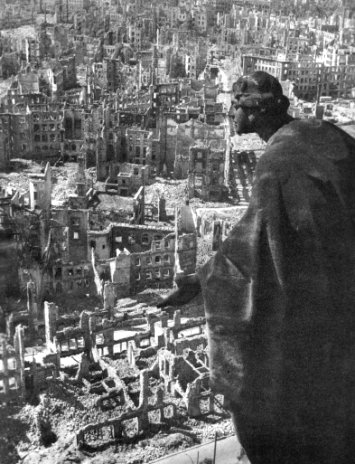 Dresden after it was bombed.
 I am not a pacifist. I think that pacificism is not the position of the Scriptures, nor even of Jesus himself (unless you edit him). But I am not comfortable with the label 'just war theorist' either. I have Christian pacifist friends whom I respect a good deal, and I owe a great deal to pacifist writers like Yoder and Hauerwas. One of the problems with pacificism in my view is that automatically you rule out the moral evaluation of acts of war because you disagree with them as a species of act in any case. I would rather allow for the possibility that 'war' is sometimes a necessary action in the pursuit of justice and the protection of the innocent - even if such a war has never been fought.
Two books I have been reading have touched on the appalling futility of war: Martin Gilbert's excellent Somme: The Heroism and Horror of War and A.C. Grayling's Among the Dead Cities - a ethical evaluation of the targeting of civilian populations in war (the answer is 'no, it is never justified' by the way).
Of course, it is no news to discover that war is appalling in almost every respect. Grayling's book shows that even in the case of a (by general consensus) morally 'justified' war (WWII) there were terrible atrocities committed by the victors - in the name of their good cause. The good cause did not sanctify the actions of those who possessed it, clearly.
The reading of these books made me all the more determined to question the West's ongoing pursuit of, and belief in, military action as a geo-political solution all in the name of liberal democracy.
Tuesday, September 11, 2007
Williams on Wiles II
Williams is not, however, happy with Wiles’ take on the way in which the transforming impact of Jesus is to be described and applied. On Williams’ account (and this is why I say rather cheekily that there is a generational dispute between the two) Wiles comes very close to the profession of a ‘very full-blooded abstract universalist rationalism’.[1] While professing agnosticism about the veracity of Christian truth-claims, in reality his stance is positively skeptical. In other words, Wiles does tend to favour the settling of issues of truth while at the same time he appears to eschew them. Like the more conservative Pannenberg, Wiles assumes for his criticism in practice the standpoint of a universal tribunal in a quasi-legal paradigm. Williams reminds us of the Kantian orgins of the idea of ‘criticism’ in this mode; and of the post-Enlightenment turn against such ‘legal’ universalism. Willaims writes:
To say that there is no universal tribunal, that pluralities of perception cannt be settled by ‘legal action’, is not necessarily to doom ourselves to irrationalist relativism. It is, though, to acknowledge that what is sustainable, what can be asserted without arbitrariness…has more to do with how particular perceptions cope with and absorb contesting claims and maintain elements of critical ‘listening’ provisionality within their own frameworks than with meeting foreordained universal conditions of legality.[2]
For Williams it is axiomatic (he uses the word ‘commonplace’) that neutrality is not available in the assessment of traditional doctrinal statements. The alternative is not, however, hopeless nihilism. Rather, it is the process of ‘coping with’ and ‘absorbing’ the various transitions along the line of Christian tradition that requires attention – a process that actually serves to ‘extend and outgrow’ even the pots in which it is planted. That is: one can’t posit beforehand the terms by which the validity of doctrinal statements ought to be judged, not least because these statements themselves exist in a dialectical relationship to the conventions of making sense, and involve, repeatedly over the course of history, the transformation and renewal of theological discourse.
[1] Ibid., p. 260.
[2] Ibid., p. 259.
To say that there is no universal tribunal, that pluralities of perception cannt be settled by ‘legal action’, is not necessarily to doom ourselves to irrationalist relativism. It is, though, to acknowledge that what is sustainable, what can be asserted without arbitrariness…has more to do with how particular perceptions cope with and absorb contesting claims and maintain elements of critical ‘listening’ provisionality within their own frameworks than with meeting foreordained universal conditions of legality.[2]
For Williams it is axiomatic (he uses the word ‘commonplace’) that neutrality is not available in the assessment of traditional doctrinal statements. The alternative is not, however, hopeless nihilism. Rather, it is the process of ‘coping with’ and ‘absorbing’ the various transitions along the line of Christian tradition that requires attention – a process that actually serves to ‘extend and outgrow’ even the pots in which it is planted. That is: one can’t posit beforehand the terms by which the validity of doctrinal statements ought to be judged, not least because these statements themselves exist in a dialectical relationship to the conventions of making sense, and involve, repeatedly over the course of history, the transformation and renewal of theological discourse.
[1] Ibid., p. 260.
[2] Ibid., p. 259.
Williams on Wiles I
Rowan Williams’ contribution to the festschrift for Maurice Wiles[1] sketches out, with characteristic elegance and urbanity, some aspects of shared commitment to a critical approach to the study of the truth and adequacy of doctrinal statements. Though the two theologians were colleagues at Oxford during the 1980s, what becomes readily apparent is that they were of different generations. Wiles, as Williams presents him, was to be thanked for asking the right questions about Christian doctrine – inquiring, for example, as to the production and rhetorical purpose of doctrinal statements.[2] Wiles was raising the pertinent problem of how traditional doctrinal statements, concieved as they were in particular historical and intellectual conditions that are nigh on unrecoverable from the contemporary standpoint, might now be received. For Wiles, the propositional truth of the doctrinal formulae was only of secondary interest: he argued that the real focus ought now to be in the ‘experiential impulse’ (Williams’ phrase) that generated them. Doctrinal claims (such as the incarnation) in the patristic era arose rather haphazardly out of a impulse to find an ontological ground for the dramatic experience of the transforming impact of Jesus. Whatever else, Wiles affirms that Jesus does make a difference. The challenge of doctrinal criticism (offered by Wiles, and which Williams accepts) is to ‘read’ this difference, and, furthermore, to read properly the first and subsequent ‘readings’ of him.
[1] Maurice Wiles (d. 2005) was Regius Professor of Divinity at Oxford University from 1970-1991; and was most famous for being a part of the publication in 1977 of The Myth of God Incarnate
[2] ‘…Wiles has succeeded in placing on the map of Anglophone theology a set of issues of the first importance’. Rowan Williams, "Doctrinal Criticism: Some Questions," in The Making and Remaking of Christian Doctrine : Essays in Honour of Maurice Wiles, ed. Sarah Coakley, David A. Pailin, and Maurice F. Wiles (Oxford: Clarendon Press, 1993), p. 240.
[1] Maurice Wiles (d. 2005) was Regius Professor of Divinity at Oxford University from 1970-1991; and was most famous for being a part of the publication in 1977 of The Myth of God Incarnate
[2] ‘…Wiles has succeeded in placing on the map of Anglophone theology a set of issues of the first importance’. Rowan Williams, "Doctrinal Criticism: Some Questions," in The Making and Remaking of Christian Doctrine : Essays in Honour of Maurice Wiles, ed. Sarah Coakley, David A. Pailin, and Maurice F. Wiles (Oxford: Clarendon Press, 1993), p. 240.
Monday, September 10, 2007
Wannenwetsch on managerialism
I attended only one paper at the Society for the Study of Christian Ethics Annual Conference, that by my own supervisor. The theme of the conference was 'The Ideology of Managerialism in church, politics and society'.
Bernd Wannenwetsch's paper was titled: 'The Birth of Economisation of the Church: Out of the Spirit of Protestant Inwardness'.
His very strong thesis was that the churches were succombing to the temptation of managerialism with its emphases on outcomes, meeting felt needs, efficiency and benchmarking. He cited the case of the Evangelical Church in Germany (EKD) who had hired the management consultants McKinsey to advise them and to help them with recruitment. This was, as Wannenwetsch saw it, the church selling out the church by commodifying the gospel.
When the gospel is tailored to meet the needs of the supposed target audience, then we lose the Reformation emphasis on the externality of the word. The church has its identity as a listenting/hearing church in response to the gospel. It is a creature of the Word. It does not have the gospel as a possession to offer in order to meet people's spiritual needs.
He sourced this turn back to Schleiermacher's Romantic era inwardness: that the logos is found inside every person 'always already', and only needs the church to connect with it in some way contrasts with the Lutheran teaching that the gospel comes to us from outside of us. We have shifted from a doctrine of the Word to a doctrine of Faith. Now, human needs and not the gospel are seen as inexhuastible. The church becomes not the hearing and obedient church, but rather the spiritually expert church.
The great biblical passage that he reminded us of was the challenge between the prophets of Baal and Elijah on Mount Carmel. The sheer dynamism of the power of Yhwh contrast with the ineptitude of Baal. Elijah does not need to imprecate Yhwh, but rather to wait on him.
As Wannenwetsch said: 'The gospel has not come to meet our needs but to transform our needs into something worth having'.
SO: the spirit of managerialism is... a demonic spirit!
Bernd Wannenwetsch's paper was titled: 'The Birth of Economisation of the Church: Out of the Spirit of Protestant Inwardness'.
His very strong thesis was that the churches were succombing to the temptation of managerialism with its emphases on outcomes, meeting felt needs, efficiency and benchmarking. He cited the case of the Evangelical Church in Germany (EKD) who had hired the management consultants McKinsey to advise them and to help them with recruitment. This was, as Wannenwetsch saw it, the church selling out the church by commodifying the gospel.
When the gospel is tailored to meet the needs of the supposed target audience, then we lose the Reformation emphasis on the externality of the word. The church has its identity as a listenting/hearing church in response to the gospel. It is a creature of the Word. It does not have the gospel as a possession to offer in order to meet people's spiritual needs.
He sourced this turn back to Schleiermacher's Romantic era inwardness: that the logos is found inside every person 'always already', and only needs the church to connect with it in some way contrasts with the Lutheran teaching that the gospel comes to us from outside of us. We have shifted from a doctrine of the Word to a doctrine of Faith. Now, human needs and not the gospel are seen as inexhuastible. The church becomes not the hearing and obedient church, but rather the spiritually expert church.
The great biblical passage that he reminded us of was the challenge between the prophets of Baal and Elijah on Mount Carmel. The sheer dynamism of the power of Yhwh contrast with the ineptitude of Baal. Elijah does not need to imprecate Yhwh, but rather to wait on him.
As Wannenwetsch said: 'The gospel has not come to meet our needs but to transform our needs into something worth having'.
SO: the spirit of managerialism is... a demonic spirit!
Theology as pure method?
This summer I obtained two books for my 9-year old son to read - The Philosophy Files 1 and 2 by Stephen Law.
They are quite brilliantly conceived books, using a dialogical style to introduce kids to the great issues of philosophical debate. Law is able to give the arguments for both sides in most instances, and then prompts some further questions. We had great fun talking about whether eating meat was ok, for example.
My thought was, why aren't there similar books on theology for Simon's age group: books that are fun, stimulating, don't talk down, don't provide cheap easy answers and have cool pictures in them?
But then a further realisation: Law is able to do what he does because he presents philosophy as a method of thinking rather than any particular set of thoughts. Essentially, as he offers it, philosophy means developing your skill in rational thinking (it's a very English view!). What answer you come to on the various questions is in the end irrelevant pretty much: it is the process of thinking them through that concerns him. And it makes for a more interesting book because it is open-ended in this way.
Can theology be presented like this? Can we say 'this is good theological thinking' without actually resolving some of the questions the philosopher is happy to leave unresolved? How could you then present theology to intelligent 9-13 year olds as not merely a set of answers but a way of thinking?
They are quite brilliantly conceived books, using a dialogical style to introduce kids to the great issues of philosophical debate. Law is able to give the arguments for both sides in most instances, and then prompts some further questions. We had great fun talking about whether eating meat was ok, for example.
My thought was, why aren't there similar books on theology for Simon's age group: books that are fun, stimulating, don't talk down, don't provide cheap easy answers and have cool pictures in them?
But then a further realisation: Law is able to do what he does because he presents philosophy as a method of thinking rather than any particular set of thoughts. Essentially, as he offers it, philosophy means developing your skill in rational thinking (it's a very English view!). What answer you come to on the various questions is in the end irrelevant pretty much: it is the process of thinking them through that concerns him. And it makes for a more interesting book because it is open-ended in this way.
Can theology be presented like this? Can we say 'this is good theological thinking' without actually resolving some of the questions the philosopher is happy to leave unresolved? How could you then present theology to intelligent 9-13 year olds as not merely a set of answers but a way of thinking?
Friday, September 07, 2007
A good lecturer...
1. Doesn't spoon-feed the students, even when they beg and beg and beg. Never hand out full text notes, or make them available.
2. Stimulates futher thinking and reading rather than provides the definitive answer for all time. But doesn't shy from conclusions either.
3. Gives you an account of the views of others, but is unafraid to give their own opinion - with passion if necessary. Prejudice is a wonderful pedagogical tool!
4. Gives a brief but quality reading list.
5. Is disciplined about questions, and is even quite harsh with rambling or hectoring questioners if necessary. Perhaps he or she makes clear how questions are going to run before the lecture. If there is no time, then tough.
6. Is disciplined about discussions or other in class activities.
7. Does check to see if he or she is being listened to, and asks for clarification questions.
8. NEVER belittles other students for a laugh. In fact, is secure enough not to have to be funny all the time.
9. Makes time for female students to ask questions, speak, talk, interact etc.
10. Starts on time/finishes on time.
11. Never or rarely runs out of time: but each lecture is presented whole.
12. Makes an effort to communicate with colour and variety.
13. Isn't obsessed with powerpoint.
14. Provides a simple outline. One A4 sheet is sufficient.
15. Appears to be enjoying him/herself.
16. Gives clear and simple information about assessment. Doesn't spend too long fussing about it.
17. Is accessible outside the class room.
18. Knows what he or she is actually talking about.
19. Is not defensive when questioned, but firm.
Can you add to the list?
2. Stimulates futher thinking and reading rather than provides the definitive answer for all time. But doesn't shy from conclusions either.
3. Gives you an account of the views of others, but is unafraid to give their own opinion - with passion if necessary. Prejudice is a wonderful pedagogical tool!
4. Gives a brief but quality reading list.
5. Is disciplined about questions, and is even quite harsh with rambling or hectoring questioners if necessary. Perhaps he or she makes clear how questions are going to run before the lecture. If there is no time, then tough.
6. Is disciplined about discussions or other in class activities.
7. Does check to see if he or she is being listened to, and asks for clarification questions.
8. NEVER belittles other students for a laugh. In fact, is secure enough not to have to be funny all the time.
9. Makes time for female students to ask questions, speak, talk, interact etc.
10. Starts on time/finishes on time.
11. Never or rarely runs out of time: but each lecture is presented whole.
12. Makes an effort to communicate with colour and variety.
13. Isn't obsessed with powerpoint.
14. Provides a simple outline. One A4 sheet is sufficient.
15. Appears to be enjoying him/herself.
16. Gives clear and simple information about assessment. Doesn't spend too long fussing about it.
17. Is accessible outside the class room.
18. Knows what he or she is actually talking about.
19. Is not defensive when questioned, but firm.
Can you add to the list?
I'm not old
From Monty Python and the Holy Grail...
[thud]
[King Arthur music]
[thud thud thud]
[King Arthur music stops]
ARTHUR:
Old woman!
DENNIS:
Man!
ARTHUR:
Man. Sorry. What knight lives in that castle over there?
DENNIS:
I'm thirty-seven.
ARTHUR:
I-- what?
DENNIS:
I'm thirty-seven. I'm not old.
I couldn't agree more...
[thud]
[King Arthur music]
[thud thud thud]
[King Arthur music stops]
ARTHUR:
Old woman!
DENNIS:
Man!
ARTHUR:
Man. Sorry. What knight lives in that castle over there?
DENNIS:
I'm thirty-seven.
ARTHUR:
I-- what?
DENNIS:
I'm thirty-seven. I'm not old.
I couldn't agree more...
Cruelty - the worst thing we can do?
 As Richard Rorty tells it (and he gets this from Judith Shklar), a liberal is someone who thinks that 'cruelty is the worst thing we do'.
Shklar herself wrote:
Sins are transgressions of a divine rule and offenses against God; pride, as the rejection of God, must always be the worst one, which gives rise to all the others. Cruelty, as the willful inflicting of physical pain on a weaker being in order to cause anguish and fear, however, is a wrong done entirely to another creature. When it is marked as a supreme evil, it is judged so in and of itself, and not because it signifies a rejection of God or any other higher norm. It is a judgement made from within a world where cruelty occurs as part both of our normal private life and our daily public practice. By putting it irrevocably first—with nothing above it, and with nothing to excuse or forgive acts of cruelty—one closes off any appeal to any order other than that of actuality.
Cruelty stands alone as a kind of self-referencing evil: for Shklar it is evil on its own terms and not because of some higher norm. Christians may loath cruelty, but unless they put it first and worst, she argues, they will always find a reason somewhere to excuse it. She sites Christian history to prove it - the terrible episode of the Conquistadors being just one.
Of course, liberal democracies have also been complicit in cruelty - whether by participating in economic systems which produce it or by the explicit use of torture in war.
Subscribe to:
Posts (Atom)